Thursday, 19 May 2022

The sage of sonic Universes: R.I.P. Vangelis (1943-2022)


A kid, aged eight and a half, is mesmerised by an episode of something called Cosmos, made by a superb scientist (Carl Sagan) he never heard of, airing on the national TV channel of a Communist country in the grips of a dictator, at the end of the 1970s... 

To see this on the propaganda-saturated, unwatchable TV channel, which was only airing anything for a few hours per day, was a stunning experience in itself. 

But the little kid got hooked, quasi-obsessed, with the main theme of the series. The stars and galaxies were flowing in the vast Cosmos, accompanied by a piano motif, then the music built into an orchestral and electronic ocean, finishing off with celestial choirs...

It was nothing the kid heard before and it was, at the same time, Earthly, passionate, sublime, and otherworldly. Somebody called Vangelis was listed as composer. 

In 2022, an almost fifty-one year old former kid, with vast music collection ranging from 12th century Early Music to space ambient electronica, is in disbelief... as the man who triggered his interest in music that transcends any categorisation, any temporal and spatial limit, is gone. 

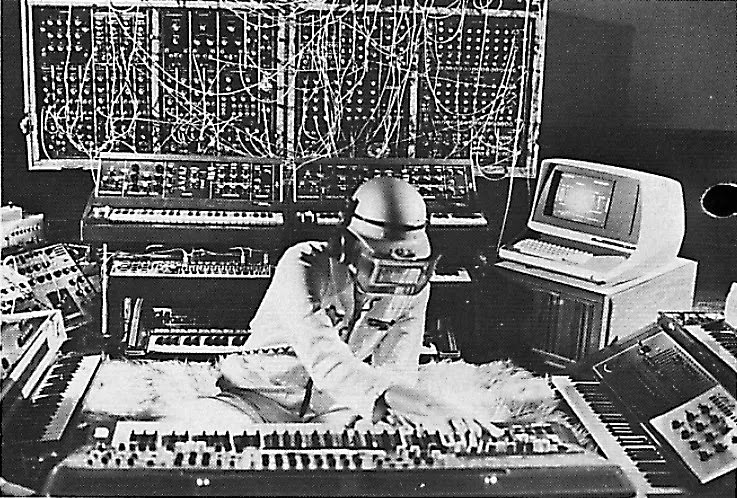
Vangelis Papathanassiou, the Greek composer, multi-instrumentalist, pioneer of synthesizer music of a unique kind, has passed away aged 79 in France, on the 17 May 2022. 

The obituaries inundating the international press at the moment, hours after the announcement, are making ostinato-like repeated references to his Oscar winning film score for Chariots of Fire, to his era-defining and endlessly imitated, sub-genre creating soundtrack to the legendary Blade Runner, to his trailblazing years in the prog rock band Aphrodite's Child, to his collaborations with myriad musicians, to his many other soundtrack works.

But there are aspects of his life and music that even in 2022 are unique or, at best, very seldom found in contemporary music. 

Vangelis never cared about what instruments made the unimaginable range of sounds he used. He stated many times that he "happened" to use synthesizers as he just found it easier to create the previously unheard sounds he imagined. He thoroughly rejected the terms electronic music or electronic musician - these labels, as his discography proves, were meaningless. 

He proved that not the tools, but their uses matter - synthesizers never sounded so warm, passionate, epic as in his creations at a time where countless others were diving into electronic styles that put the technology at the centre. Some to this day rage endless debates online about nonsensical sub-divisions of synthesizer categories and define themselves by the tools they use. Vangelis was and remained the antithesis of all that.

Vangelis never cared about genres - and could instinctively inhabit, recreate, convey the spirit of countless historic periods and ethnic tradisions. Time and space seized to exist, countless ancient traditions, styles, genres and sub-genres met seamlessly in his music... As Ridley Scott once said, Vangelis could effortlessly sound Medieval and contemporary at the same time. 

And here comes the clencher. 

The man who composed everything from progressive rock to jazz and jazz rock, from African tribal music to Celtic ballads, from Far Eastern lullabies to space ambient, from Medieval choral and instrumental music to fiery and Earth-shattering cosmic electronic epics... never formally learnt music, never read or wrote music. 

His Direct system invented in the later 80s allowed him even more what he was doing before: largely improvised creations emanated from his sonic wonderland... with zero regard to the contorted artificial categorisations the music press tried to squeeze his compositions into. 

His discography is impossible, it cannot exist - yet it does. Not long ago this blog posted a quick "inventory" of the utterly mindblowing range of styles, genres, and sub-genres he composed in.

It could not have been composed by one man, it is just impossible that a single person could span millennia and tens of thousands of miles of musical traditions and styles. Yet it was composed by a formally never musically trained man. 

What it meant to listen to his musical Universe during a Communist dictatorship, as a sonic escapism filled with wonder, is impossible to describe for the former little kid who got blown away by the main theme from Cosmos. 

What it meant in subsequent decades to discover the truly limitless sonic Universe Vangelis could create... is also impossible to describe.

May He rest in peace, reunited with the music of the Universe, which, as he often humbly said, was merely channeled by him. He maintained that he never composed anything... he just managed to hear what the Universe was creating.

Thank you, Grand Master of wondrous sounds. 


Wednesday, 27 April 2022

The Master of sonic galaxies: R.I.P. Klaus Schulze


Klaus Schulze, a truly unique trailblazer, a relentless musical innovator with colossal discography filled with superhuman epic journeys through galaxies of sounds... has died on 26 April 2022. 

It is an over-used expression, but in His case, true to the letter: a unique mind, a unique spirit, a unique musician. To the very end, despite his colossal achievements, he remained charming, gentle, even self-parodising, with a lucid and stunningly honest view of his own artistic achievements.

My "first" was the impossible to describe or even grasp Timewind, when I was almost 14 - and it was something literally out of this world, it was like nothing ever heard or imagined to hear ever. It was the start of decades of excited discoveries. 

It was something that taught me: there is music that breaks every convention, every preconception - it just emanates from the fabric of the Universe, it surrounds you, it evolves and it cannot be poured into words chosen by a feeble ordinary human mind. One just had to surrender oneself to it and embark on a journey beyond journeys.

So a huge thanks for many decades of just superhuman meditations, of sound worlds that just came into being and evolved with myriad scintillating details. 

An era has ended - not just in electronic music. If Yannis Xenakis in his avantgarde and seminal Musique Formelle talked about galaxies of sounds, when modeling mathematically musical events, well, Klaus Schulze created those with pure human spirit and emotion.

He made impossible music possible - and instantly recognisable as something coming out of His studio, His mind. 

Even his collaborations are stellar, and out of this world. Who would have thought Lisa Gerrard's vocal improvisations will meet in something truly unique with the electronic Grand Master's improvisations? Or that Wolfgang Tiepold's phenomenal and heartfelt cello improvisations would blend with intricate electronics so well? And then we have Ash Ra Tempel, we have Tangerine Dream at the beginnings, to name just a few more giants of the musical landscape.

May He rest in peace and travel among unimaginable galaxies of sounds of a very special Universe he managed to give us glimpses of.


Sunday, 17 October 2021

Men, maths, and machines: Stochastic by Carbon Based Lifeforms


Stochastic music, as an actual term and method, really has its origins in Yannis Xenakis's seminal work from the 1960s, entitled Formalized Music (Musiques Formelles). 

Essentially, random processes not only produce musical events in stochastic compositions, but they can be directed and/or constrained such that they can even create musical pieces of a certain style or genre. Creating a systematic mathematical treatise on this topic was an utterly groundbreaking move. 

Of course, in 2021, we have the luxury of looking back at decades of genuine computer music - i.e. musical works that were created not just on, but by computers. With the advent of personal computers, one could create such works at home, tinkering with stochastic processes or elaborate mathematical algorithms (for example, in the case of fractal music).

Computer compositions reliant on random elements were no longer confined to the laboratories with huge and terrifying looking computer monsters. Once upon a time, the stunningly human and mesmerising Illiac Suite could only be created on such a monstrosity, the ILLIAC computer at the University of Illinois.

Many have ventured into the realm of computer music, after all, even the ambient music luminary Brian Eno has built bridges between ambient and generative music.

We are almost at the end of 2021 now, and the ambient/psybient duo Carbon Based Lifeforms surprised fans by the release of an album called Stochastic. 

The album returns to the sonic world of their earlier ambiental albums like VLA and Twentythree.

The way in which this album was created is eminently different, though. Well, you may have guessed it, stochastic processes were applied in order to generate the sound sequences and textures. 

As the authors describe it, the tracks were born from exploiting the random features of some of their synths, and they were left alone to do their things... creating evolving textures, layers, and motifs. 

The track titles are firmly rooted in the world of maths and algorithms, apart from some poetic ones like Hello From The Children Of Planet Earth. Titles like Eigenvector, Finite State Space, Sphere Eversion are straight out of the world of vector algebra, control theory, and topology. 

One key aspect to highlight here is that the album does not contain what some may fear: these are not academic unlistenable experimentation, alien and alienating random sounds, or products of some purely theoretical adventure in areas of mathematics that nobody may understand. 

The album does sound remarkably identifiable as a CBL album. It has dreamy textures, floating layers of sonic bliss, and memorable evolving motifs. 

What is often forgotten when some discuss computer-generated music is that ultimately, it is still the human producing the end result. 

That human input may be merely a selection process of picking out pieces or entire tracks from the randomly generated output. It may be human involvement in the constraints imposed on the pseudo-random processes. It may be human control of numerous parameters, algorithms, stochastic processes. It may be human choices in the processing of the resulting sounds, e.g. via choices of effects.

Where the machine ends and where the human begins in computer-generated music is often a futile debate. 

We, as listeners are hearing the end result of a 'collaboration' between man and machine, where the machine was given more freedom than in normally composed and performed electronic music. 

When listening to Stochastic, at least this reviewer would recommend something perhaps scandalous to the listener: let's forget analysing where that delimitation line between the human crew of CBL and the synths may be. Let's not treat it as a highly technological record...

It is ethereal, pleasant, non-intrusive music but by no means for passive listening. There are endless details and myriad changes of subtle or tidal nature, there are tiny evolutions of sounds and there are vast swells of sounds. There are passages that are genuinely uplifting, expansive, and infused with what seems to be human emotions.

It comes across as a wholly enjoyable, varied, and quite human album. 

As Bill Laswell once wrote, Computers and electronic music are not the opposite of the warm human music. It's exactly the same...


Sunday, 8 August 2021

Returning from turbulent seas: Paul Haslinger's Exit Ghost II


Being an influential member, even if temporarily, of a legendary band with individual voice in the global music landscape can affect later on the way in which the band's fans react to one's solo albums... especially when those significantly depart from what is "expected" by those fans. 

If a band is as long-lived and influential as Tangerine Dream is, then its ex-members' solo efforts inevitably get compared by fans, and not just, to the style and sonic universe of the TD albums from various eras. 

When Christopher Franke released his highly visual, descriptive (thus, in classical terms, program) music on his first solo album (Pacific Coast Highway), there were not only ovations... but also dismay from some. It was not "like TD". It was "disappointingly" not TD. 

Paul Haslinger, another notable name in Tangerine Dream history, has quite a few soundtrack, solo, and collaborative albums under his belt. Even so, his fragile, almost translucent, ethereal album Exit Ghost stunned some - not in a positive way. It was a radical departure not only from TD, but also from his own previous creations... 

Probably similar things happen with the new album, Exit Ghost II... One can always judge a composer by the musical range he/she is capable of (even if one is not subjectively enjoying some segments of that range), or one can just judge it by comparisons with what is "expected". In latter case, it seems useful to provide a very early hint to those listeners - and let them know that this album, too is a radical departure from "expected" TD-like music. 

Its predecessor was born under exceptional circumstances - and this sequel comes just when the world is trying to return from the lengthy shock that was Covid's arrival. 

To quote, the album was "born out of an incessant need to escape the trauma that has gripped the world for the last year coupled with an urge to complement the introspective and moody atmospherics of the last record, ‘Exit Ghost II’ is the counter-element that closes the circle".

The very first things to remark is that it does have a wider sonic range, with even orchestral textures - it does feel more luminous and emotionally charged. However, it still has that sublime quality that we heard on the first album, and entire passages of it can only be compared to the gentle, remarkably introspective soundscapes we hear on Ryuichi Sakamoto's Async or many Olafur Arnalds albums. 

Cambium, the opening track does place us in the minimalist, charming, piano- and electronic percussion-based Universe we may hear on Arnalds albums. Other piano-centric tracks like Septuagint are playful, adventurous, this particular one playing with 7/8 time signature that is refreshing to hear after so many metric tonnes of firmly 4/4-based electronic music...

Emerald is an example of the ethereal beauty Haslinger can conjure from some floating electronic textures and a few perfect gems of piano motifs. Translucent, exactly as the title suggests, is another example, where choral sounds are at the same time Earth-bound and otherworldly. 

Waltz II and Inversion III return us to a piano-based sonic world, with the former bringing lovely melancholy, while the latter moving out into more experimental-sounding chromaticism.

Mishkin has again an ethereal feel that can be perhaps described as something that Thomas Newman fans would love: fragile, translucent textures punctuated by gentle piano chords. So is Schubert IX Coda, which combines infinitely delicate electronics with subtle piano notes and chords.

The closing track, A Young Fellow is not only standing out with its rich orchestral feel, but it is also charming with its use of voice samples - and overall an uplifting, optimistic ending to the album.

As the notes of the album state, Paul Haslinger’s ‘Exit Ghost II’ is the composer’s quest for arrival after a year lost at sea. 

After a bizarre and in many ways dark, anxiety-permeated year, this follow-up album, ending with aforementioned uplifting track filled with optimism, is really a successful antidote to 2020's dark clouds...


Friday, 30 July 2021

Juno To Jupiter: the new Vangelis album has a release date


After a much troubled release process, which completely stalled due to unknown reasons after one classical music site started to sell digital download of the album material... the epic new Vangelis album has a release date.

According to several announcements, it is to be released on 24 September 2021. A full review of the album was posted on this blog and it can be found here.

The Decca announcement in full, below:


VANGELIS

"JUNO TO JUPITER"

AT THE DAWN OF CONSUMER TRAVEL INTO SPACE,
JUNO TO JUPITER IS A MULTI-DIMENSIONAL MUSICAL JOURNEY IMMERSED IN
SOUNDS FROM THE COSMOS

THE RECORDING BY VANGELIS FEATURES

ANGELA GHEORGHIU, SOPRANO, AS JUNO

CD ALBUM AND DIGITAL RELEASE BY DECCA RECORDS ON SEMPTEMBER 24TH
VINYL AND A LIMITED EDITION BOX SET TO FOLLOW

Decca Records announces the release of Vangelis' new album "Juno to Jupiter" on September 24. The album will be available on CD and digital formats, with vinyl and a limited edition box set to follow.

The work, inspired by NASA's ground-breaking mission by the Juno space probe and its ongoing exploration of Jupiter, is a multi-dimensional musical journey featuring the voice of opera superstar Angela Gheorghiu. The album includes sounds from the Juno launch event on earth, from the probe and its surroundings and Juno's subsequent journey that have been sent back to earth from the probe, which continues to study Jupiter and its moons: 365 million miles away from the earth at its closest point.

The Juno mission, one of NASA's most challenging and scientifically ambitious planetary missions ever attempted, is named so after Hera (in Roman Juno), who, according to Greek mythology, was the mother of Gods and humans and the wife of Zeus, in Roman Jupiter, who was the father of Gods and humans. In order to hide his mischiefs, Jupiter drew a veil of clouds around himself. However, Hera/Juno was able to peer through the clouds and discover her husband's activities with her special powers. Similarly the Juno spacecraft is looking beneath the clouds revealing the planet's structure and history and how our solar system has been formed.

"I thought to put emphasis on the characteristics of Jupiter/Zeus and Hera/Juno that according to the Greek Theogony, had a special relationship. I felt that I should present Zeus/Jupiter only with sound, as the musical laws transform chaos into harmony, which moves everything and life itself. Unlike, for Hera / Juno, I felt the need for a voice. Angela Gheorghiu, represents in this historical depiction of the mission to the planet Jupiter, Hera / Juno, in a breathtaking way. " - Vangelis

This July marks the five-year anniversary of the Juno spacecraft's orbit insertion at Jupiter. Launched in 2011 from Cape Canaveral Air Force Station, Juno arrived at Jupiter on July 4, 2016. Due to its importance the mission that primarily was scheduled to be completed 31st of this July, has been extended by NASA and now Juno will continue exploring the full Jovian system - Jupiter and its moons - until September 2025.

Voices featured on the album, courtesy of NASA, include scientists Randall Faelan (Lockheed Martin, Deep Space Exploration Real-Time Operations Lead), Chris Leeds (Lockheed Martin, Telecom Sr. Engineer), Jennifer Delavan (Lockheed Martin, Spacecraft Systems) and Matt Johnson (Juno Mission Manager, JPL/Caltech).

Vangelis, a pioneer in electronic music, with his ever expanding imagination and innovative experimentations, is the one that, as no other, has made the perfect blending between the acoustic and electronic world. His orchestrations for this new album expand once again the horizons of electronic music by blurring the line between it and acoustic symphonic music which culminate in a breath-taking and in the same time soothing musical journey. Vangelis' characteristic use of synthesizers, bold brass riffs and expansive strings convey a sense of mystery about life beyond our own world, and commemorate all those who have dealt and still deal with the observation and the exploration of the stars, the planets and the Universe; and who have dedicated their lives to understanding the final frontier and the secrets of our solar system.

"The music of a film is instrumental in the feeling one gets, this idea is clear to all film makers, as the music touches our souls in a way that far surpasses the visual experience. This is the case in so many films that Vangelis has scored, and is again true for Juno to Jupiter which provides a new dimension to our connection with nature and humanity's quest to reach out beyond Earth and touch the part of us that is present throughout the solar system and beyond. " - Dr. Scott Bolton, Juno Mission Principal Investigator

Vangelis, without formal training, began playing piano at the age of four and by age six was giving public performances of his own compositions - his natural gift coming from a place he calls memory - a place he says we can all tap into if we can only remember. Since his childhood, Vangelis is constantly composing music and has released over forty albums, over twenty movie/TV soundtracks, two ballets, one modern dance performance, six plays, three choral symphonies and has major audio/visual spectaculars to his credit.

Vangelis' music is often linked to themes of science, history and exploration. Alongside his Academy Award-winning score for Chariots of Fire and his acclaimed Blade Runner music, he has written the choral symphony 'Mythodea' for NASA's 2001 Mission to Mars, as well as films including Antarctica, 1492: Conquest of Paradise and Alexander. Vangelis also collaborated with the European Space Agency (ESA) on his album Rosetta to mark the culmination of the Rosetta Mission to land a probe on a comet for the first time in history, as well as for the broadcasting by ESA into space of his CD single dedicated to the late Professor Stephen Hawking, as a mark of respect and remembrance. His music has also been used in the documentary series Cosmos: A Personal Voyage by Carl Sagan.

NASA has presented Vangelis with their Public Service Medal. Also, the International Astronomical Union's Minor Planet Center at the Smithsonian Astrophysical Observatory named the Asteroid 6354 which is located between Jupiter and Mars "Vangelis" in his honour, due to the international impact and appreciation of his work as well as his rapport with the Universe.

"Vangelis has composed all of the music for Juno videos, documentaries, and simulations of observations […]. It is not often that an Oscar-winning (and not only) composer is inspired to write music about space. So, the Juno mission has had its public impact multiplied by the unique talent of Vangelis' music. This libretto is a continuation of the Juno story.... " - Stamatios (aka Tom) Krimigis, Principal Investigator, Voyager 1 and 2

Vangelis' position and strongest wish is that we shouldn't forget that Space, Universe, Cosmos, in whichever name we call it, is our hope and future and we need to be careful not to make the same mistakes in space that we constantly made in our planet, as it is the only chance we have - our future.

Vangelis Juno to Jupiter, CD and Digital, is out via Decca on September 24 and available to preorder here. Vinyl and a limited-edition box set to follow.

CD Track list:

     1. ATLAS’ PUSH  
          Spoken word samples courtesy of NASA
     2. INSIDE OUR PERSPECTIVES  
     3. OUT IN SPACE   
     4. JUNO’S QUIET DETERMINATION 
     5. JUPITER’S INTUITION 
     6. JUNO’S POWER 
     7. SPACE’S MYSTERY ROAD  
     8. IN THE MAGIC OF COSMOS 
     9. JUNO’S TENDER CALL  
          Angela Gheorghiu, soprano, as Juno
    10. JUNO’S ECHOES 
    11. JUNO’S ETHEREAL BREEZE 
    12. JUPITER’S VEIL OF CLOUDS 
    13. HERA/JUNO QUEEN OF THE GODS 
          Angela Gheorghiu, soprano, as Juno
    14. ZEUS ALMIGHTY   
    15. JUPITER REX 
    16. JUNO’S ACCOMPLISHMENTS 
          Angela Gheorghiu, soprano, as Juno
    17. APO 22 
          Spoken word samples courtesy of NASA. (*) 
    18. IN SERENITATEM 

(*) Voices: Randall Faelan, Lockheed Martin, Deep Space Exploration Real-Time Operations Lead; Chris Leeds, Lockheed Martin, Telecom Sr. Engineer; Jennifer Delavan, Lockheed Martin, Spacecraft Systems; and Matt Johnson, Juno Mission Manager, JPL/Caltech.


Saturday, 22 May 2021

Still holding the sky - Intruder by Gary Numan


Gary Numan's compositions have often been running ahead of the times, either in terms of the music, instrumentation, lyrics... or all of the above. After the dystopian visions of Savage, the new concept album Intruder is more about the here-and-now than some imagined future - however, the sound design, music, and production aspects of the album have that otherworldly and unmistakable Numan feel that one expects. 

It is again an introspectice record, in many ways connects us with the world of one of his recent and highly personal albums, Splinter.

Each track seems to be perfectly integrated into the whole that Intruder constitutes as an album, nothing feels out of place - and remarkably, after more than four decades of creative output, at least this reviewer could not find a single track that noticeably differs from the overall feel of the album, in terms of its quality and level of engagement triggered in the listener. 

We have many tracks of an eminently anthemic quality, some with genuine head bobbing potential... Now and Forever is a perfect example, so is I Am Screaming - we may find ourselves singing along at the top of our otherwise modest voices. Numan's melodic inventiveness is still at a sustained peak - many of the melodic phrases of the album have earworm potential, and many melodies, especially in the expansive choruses, have a not often heard beauty. 

Tracks like The Gift or The End of Dragons have those Eastern touches we last heard on Savage, whilst Black Sun takes us into the world of intimate, gentle Numan compositions. If Intruder, the title track, is suitably dark and reaching for harsher metallic rock sonorities, compositions like the aforementioned I Am Screaming show that quintessential Numan characteristic: a track can go from subtle, almost whispering vocal phrases to a soaring, uplifting, and ceiling-lifting chorus in under one second. The emotional effect, the lift, such tracks give the listener are hard to put in words, but Numan fans will be very familiar with the effect. 

This album, too is a collaboration with Ade Fenton, thus in terms of production values, technical wizardry and the overall Numan-esque soundscapes, Intruder excels. It unleashes on us an instantly recognisable soundworld, across the entire range - and the album certainly has a vast range, going from delicate ballad-like passages to Earth-shattering passages. The Chosen or Is This World Not Enough are good examples of how the vast forces at work are managed, tamed, or unleashed with full force.

The electronic percussion, too is highly characteristic, decayed metal parts of dismantled androids and remains of alien spaceships are scraped, banged together, hit with other things... 

As some may hear on some M83 albums, Intruder achieves the rare mixing and mastering fete of having even the soft, subtle, even quasi-whispered vocals come across with perfecly intelligible words whilst immersed in thundering electronic textures.

The term "synth-pop" or "electro-pop", which was used for decades to label Gary Numan's music, is still in use today... But if his recent albums were not sufficient proof of the fact that the use of this label nowadays is just a lazy shorthand, then Intruder once again demonstrates this.

To paraphrase one of the lines from The End of Dragons, Gary Numan still holds the sky as a bona fide electronic music hero, with yet another fully-fledged concept album that dares to move lightyears outside current stereotypical electronica.


Saturday, 10 April 2021

Living, breathing, pulsating Amazônia - an immersive new work from Jean-Michel Jarre


Amazônia is an immersive exhibition focusing on the Brazilian Amazon, based on more than 200 photographs and other media by legendary photographer and filmmaker Sebastião Salgado. He had spent six years in the region, capturing the natural elements and the local cultures.

Electronic music legend Jean-Michel Jarre has composed and recorded a musical score for the exhibition. 

The first and rather central aspect is that this, after many years, marks a return to an ambiental, even musique concrète, soundworld that Jarre fans may know from only a few seminal works.

Apart from some of Jarre's early, pre-Oxygène, works, we have only heard this compositional approach in his sampling-based classic album Zoolook and in the mesmerising, final track of Waiting For Cousteau.

Amazônia will certainly "disappoint" Jarre fans who expect musical output that is either in the vein of unashamedly nostalgic re-visiting of classic albums like Equinoxe or in the quite heavily EDM-leaning mainstream electronic works we could hear in recent years. 

It is not an album with driving sequences and rhythm patterns, certainly not one with sonic fireworks. There is something of the intimacy of the album Sessions 2000 in this, it feels and sounds like a highly personal project with great attention to detail. 

An interesting aspect is that the album's many natural sounds are not actually field-recorded sounds, instead, they were created and/or assembled in Jarre's studio. 

It is impossible to do a track-by-track 'usual' review of the album, as it is an overall sonic experience, with numbered tracks that seamlessly flow into each other. If we think of Tangerine Dream's Zeit or Atem, Vangelis's delicate and intricately minimalistic Soil Festivities, well, Amazônia firmly positions itself in that type of sonic Universe.

Perhaps the most charming aspect of the work is how the countless tiny details combine and how they change. We have occasional appearances of melodic motifs, very subtle sequences, pulsations, but the centre stage is occupied by the sonic elements that conjur the world of the Amazon rainforest. 

It is a symphony of a very special and subdued kind, where the listener is trusted to pay attention to numerous tiny changes in the sounds and the musical elements. There are moments of 'tangible' electronic music, between ambiental soundscapes that seem to purely come into being  and exist without any human intervention.

Admittedly, this blogger admires that particular quality in some seminal works by other EM greats like the aforementioned ones and certainly in works by Klaus Schulze - thus,  in the case of Amazônia we are invited to an, overused word perhaps nowadays, immersive experience.

Amazônia simply seems to exist, filling the available space, floating in the air, with myriad infinitesimal sonic elements that arrange themselves into a veritable constellation of natural sounds. 

It is music, it is a sound, for introspective times - whilst it can be as abstract as some works by Brian Eno, the evocation of the natural world works splendidly, and gives the album a highly organic feel. 

This is not musique concrète that escaped from the labs of some electronic pioneers, not a sterile collage of natural and electronic sounds... It seems to breathe and have currents, undercurrents, pulsations of some greater organism - it has life.

As a landmark in the Jarre discography, Amazônia is a rare and unexpected change of direction after years of adventures in increasingly mainstream electronic music sub-genres. It is a surprise, and if the listener enjoyed Waiting For Cousteau or the sonic introspections of Ethnicolor from Zoolook, that listener will find Amazônia a mesmerising sonic journey.