Showing posts with label classic electronica. Show all posts

Tuesday, 30 June 2020

Fifty Years Of Unique Audentity: Klaus Schulze


Borrowing the pun of one of his landmark double albums, it seems fitting on the last day of June to look at the vast body of work of one of the most individual electronic music visionaries of our times, someone with a very unique and instantly audible identity... pardon, audentity...

In June 1970, the first album appearance of Klaus Schulze occurred. At that point he was a member of what has become a veritable institution in the electronic music sphere: the band Tangerine Dream, founded by the late Edgar Froese.

Electronic Meditation was the first and last Tangerine Dream album that featured Schulze - as he promptly moved on to establish his, by now legendary, solo career. 

Audiences may not have suspected at that time that the drummer, who joined Tangerine Dream after a brief and unreleased musical contribution in the rock band Psy Free, would become a unique and vastly (seldom successfully) imitated electronic music luminary.

His early solo albums, Irrlicht and the double LP Cyborg, presented us a daringly and unashamedly experimental musician who could conjur up entire strange worlds in as long as possible continuous compositions. Back then, the physical medium only allowed twenty-odd minutes of continuous sonic poetry... but the later Klaus Schulze of the CD era could mesmerise us with seventy-plus minutes long monumental electronic structures...

Well before "trance" entered the terminology of music, and well before it has become a label for a particular sub-genre of electronic music, Klaus Schulze was creating an unmistakeably personal and truly unique kind of electronic trance.

One could pick from his vast discography the hypnotic Timewind and Mirage from the heroic and analogue 1970s, the astounding Audentity or En=Trance from the confident and digital 1980s, the spellbinding Das Wagner Desaster or In Blue of the mature and limitless 1990s... or the epic, but intimate, Rheingold or Silhouettes of the recent years...

The one central trait of all Schulze albums has been a rare, much sought-after, and countless times attempted to be imitated feeling that this music simply comes into being, without someone playing electronic or other instruments... and it exists, flows, occupies all available space without any human intervention.

It is impossible to listen to Klaus Schulze as background electronic music. Whilst he was and is recognised as a giant of the sequencer-oriented Berlin School of electronica, Schulze's music demands close attention.

Even if, on the surface, repetitive structures or sequenced elements are present, they are full of continuously changing, morphing, flowing myriad details. The intricacies of his live or studio performances are dazzling, if one closely listens to the ever-changing sonic Universe he achieves to create in our room. 

Over the fifty years, Schulze has never stopped innovating and changing. Sure, some artistic decisions could be seen as questionable or one could point out major U-turns in his ars poetica.

The key aspect one must not forget is that artists like Schulze have experimented with sometimes wild departures in highly unexpected directions, instead of standing still. We may wish that we had been treated to countless repetitions of Timewind and we may go misty-eyed when thinking nostalgically of the musical world of Dune or X

However, as in the case of Tangerine Dream, one has to realise that instead of self-repetition, such artists were daring enough to constantly seek out new directions, experiment with even never before touched technologies, and move with the times - or, actually, define those times. 

He has treated us to superhuman-looking and -sounding live improvisations, impossible to dissect and mind-blowingly complex whirls and galaxies of sequencer patterns, vast floating sonic ambiences before ambient music became a term, trance-inducing grooves before trance music became a term, imaginative and daring use of sampling, collaborations with legendary musicians as far from electronica as one could possibly imagine... Who would have thought the legendary  Lisa Gerrard's vocal improvisations would perfectly and astonishingly blend in with Schulze's vast sequenced structures in a live setting, too?... 

It might be impossible for an avid electronic music, or even Klaus Schulze, fan to like all his live and studio albums... However, the one constant we can easily hear on his albums, irrespective of the fundamentally different sound worlds he has experimented with over half of a century, is that Schulze sound...

What is it exactly? The long flowing compositions? The mind-bendingly complex and constantly shifting sequencer work? The superhuman improvisations running through the fluid soundscapes? The seamless combination of ancient sonorities, even ethnic vocals, ocean-deep sonic textures, and fiery improvised leads?


Even after fifty years of album releases, one cannot be sure... but as soon as previously unknown to me Schulze album or composition popped up on radio or elsewhere, I used to jump: that had to be Schulze!.. and it was.

If there was one person who would, not too strong of a word, hate pigeonholing his vastly varied musical output, it would be Schulze himself. 

As the grand master put it in a recent interview, "Remember ‘fusion’ once? Or ‘jazz rock’? And in 1990 it was for some parts of electronic music ‘acid’, ‘acid jazz’, ‘house’, ‘deep house’, ‘Detroit techno’, ‘rare groove’, ‘New York garage’, ‘industrial’, ‘Latin hip hop’ et cetera. All these fashionable coming-ups of words are not the terms and definitions I think or care much about. I am neither a swish sociologist nor a smart journalist but just a dull little musician who’s doing and enjoying his very own doings, and I call it ‘music’.”

Thus... thank you for fifty years of live and studio albums of music, Maestro... and may we be spoiled by further sonic creations in the future...


Friday, 11 October 2019

Nostalgia, renewal, and Tangerine Dreaming


Nostalgia is a powerful force. If one is tempted to say that the previous statement mainly applies to marketing nowadays, many great writers and poets of the Romantic era would have a chuckle if they could hear that opinion.

Susan Stewart wrote not too long ago that nostalgia is basically “a longing that of necessity is inauthentic … because the past it seeks has never existed except in narrative."

Thankfully, music fans falling into the (most often) deeply pleasing trap of nostalgia can say that, well, they are in a privileged position. The past that they seek is instantly reproducible by replaying a piece of recorded music, it is tangible when they lift the physical medium off the shelves of a record collection.

Still, there are cases where nostalgia, as pleasing as it may be, can become a hindrance to fully appreciating and enjoying novel artistic works

A rather unique situation is when a concept, a brand, or even a quasi-institution in art lives on after the originator or founder has passed away. 

Examples of such situations in pop culture abound. Is Spider-Man still Spider-Man after the passing of Stan Lee and Steve Ditko? Is Star Trek still Star Trek long after the passing of Gene Roddenberry?

In classical music, was the splendid Hilliard Ensemble still unquestionably Hilliard Ensemble long after the founding member (Paul Hillier) left?

Even without asking the respective fans, one would be able to say, resoundingly, "yes". The absence of various degrees of outrage rooted in nostalgia is basically absent when it comes to these names and brands.

Thus, before these introductory musings get even more unbearably long, we arrive at a rather unique phenomenon in electronic music. Perhaps in music, in general.

Tangerine Dream is a veritable institution in trailblazing electronic music.

One can say this not merely based on their vast discography, their era-defining seminal studio and live albums, or their classic soundtracks to landmark films. With all the technological and artistic pioneering work that TD's founding father, Edgar Froese, and the many visionary musicians who were and/or still are members of Tangerine Dream have created, this band has really earned a unique place on the firmament of electronica.


Therefore, perhaps it is no surprise that the post-Edgar Froese Tangerine Dream can trigger very strong nostalgia... and very strong subjective opinions, too.

On social media one can see comments along the lines of "this is not Tangerine Dream". One could see even factually untrue, or at best inaccurate, labels like "cover band". The chorus of outrage from hardened fans reading or hearing such opinions can surpass the Earth-shattering pulsations of those trademark Tangerine Dream bass sequences...

During the introduction, with therein mentioned examples from pop culture and classical music, the case of "X is no longer X" after the passing of a creative central figure was hopefully put to rest.

To say that TD is not TD, despite its founding father's explicit wish to continue with the concept, despite the vast array of instantly recognisable characteristics of their music, despite the absolute adherence to the core principles of what made TD the phenomenon that it still is... well, it would be historically and musically erroneous.

A concept does survive and it has full rights to be respected under its original name - if it stays true to itself.

This then lands us in the topic of imitation or, heaven forbid, mere repetition - since some commented that the current TD is merely a "cover band".

In some ways, this has some positive element in it, as it recognises that the brand stays true to what it stands for - even if it wants to deny the presence of continued creativity.

Whilst one should respect opinions, one should, and easily could, objectively refute claims that the current Tangerine Dream lineup constitutes a cover band that just renders tracks from the immense back catalogue.

Why objectively, in such a subjective and abstract form of art that is music?

Well, if one considers current TD a cover band then one disregards important facts: the existence of a critically much celebrated new studio album and the series of epic live compositions that have, thankfully, become a constant presence in TD live appearances.

One should ask the skeptical and eminently nostalgic TD fan: when was the last time that he/she heard such compositions at a "classic" TD concert or on a TD album that pre-dates the current lineup?

We have waited decades to hear what the post-Edgar Froese lineup is treating us to. If a cover band delivers often 40- or 50-odd minutes of new and instantly recognisable Tangerine Dream compositions as improvised live sessions, then we must really rewrite the definition of the term "cover band".

Paddling onto less objective waters, the understandably nostalgic, but intriguingly non-objective, voices seem to also disregard the wider picture.

Namely, Tangerine Dream has constantly evolved and changed, even if sometimes in much
questioned artistic directions. An essential part of these changes was also the series of changes in lineup.

In that sense, Thorsten Quaeschning (who worked with Edgar Froese since 2005!), Hoshiko Yamane, Ulrich Schnauss, and the recent (utterly splendid) appearances by Paul Frick are another very natural phase in the epic saga that is Tangerine Dream.

Joan Baez once wrote:  "My dread is for my show to be a nostalgia act. So the key to it is how do we keep it fresh?"

In the case of Tangerine Dream, whilst one can understand and appreciate the nostalgia that is at work behind aforementioned negative takes, the relentless creativity, astonishing musicianship, and continued innovation one can witness in every new album and live appearance is something to be celebrated.

Those are the elements that are keeping TD fresh, as is a faithfulness to the TD concept. If we listen to the new versions of classic tracks, we can hear how thoughtful and sensitive the new takes are. Sure, this is a subjective matter, but comparing some rather aggressive reworkings pre-dating this lineup and the new takes on classics is a very interesting exercise - and comes very recommended when nostalgia overtakes us.

Whilst we can certainly reminisce when we listen to Phaedra, Ricochet, Stratosfear or Poland (or many more from the astounding TD discography), we could be doing ourselves a huge disservice if we let that nostalgia suppress our senses when we are faced with the spellbinding new Sessions and musical renditions of quantum physics principles emanating from the studio and the stages where Tangerine Dream fire up their synthesizers...


(Photos by the author - Tangerine Dream Live at Barbican Hall, March 2019)


Thursday, 20 June 2019

Seeking and finding Hades: Impressions on a new Tangerine Dream box set


A poet from 6th century BC, Theognis of Megara wrote that "no man takes with him to Hades all his exceeding wealth"...

However, he had no chance of coming across the newly released Tangerine Dream box set... Both Theognis and (undoubtedly) Hades would approve of this wealth in one's possession - if only they had the chance to listen to the 16 CDs and 2 BR discs of the Virgin recordings from 1973 to 1979...

In Search of Hades not only contains splendid remasters of Tangerine Dream classic albums from the 1973-1979 period, but also numerous previously unreleased tracks that are genuinely spellbinding. The Steven Wilson mixes and Ben Wiseman-remastered versions can be heralded as examples of how informed and sensitive remastering should be done, when we are flooded with countless remastered editions of classical albums that not only over-compress the original material, but may also genuinely massacre those... The Ricochet and Phaedra remastered versions notably also restored their original structure, with material that was either cut or misplaced in some previous releases.

In addition, for the first time one can hear quality recording of certain era-defining live appearances that TD fans so far only could hear in bootleg recordings and mono radio material of highly varying "quality".

First fact to stress is that the previously unreleased material is not a mere pile of studio leftovers and obscure curiosities that stayed in dusty basements for good reason. Instead, they are astonishing electronic soundscapes that are not only musically, but also historically, significant.

The Phaedra Outtakes are of simply aching beauty, with gentle piano, flutes, strings, electronic swirls and indescribable sound effects all combining into subtle, sensitive sonic paintings that are at the same time cosmic and terrestrial, alien and human.

These recordings show again something that unashamedly biased (with good reason) TD fans have known for a long time: the way that Mellotrons are used by Tangerine Dream truly stands out, when compared to the 'raw' and typical Mellotron sounds found in countless electronic and progressive rock albums.

Among the included concert recordings, the Victoria Palace live appearance is particularly notable, as some remarked: it is an evolutionary 'missing link' between the sound world of Atem and that of Phaedra.

Not only we have here a group of fiercely innovative musicians improvising live, something that in electronic music cannot be understated, but the sonic gems of this concert have the ambient soundscapes, fluid and utterly sensitive meditations of what we could hear on the classics Zeit and Atem. These are seamlessly blending with the more melodic Mellotron strings and flutes, underpinned by tight pulsating sequencers, a novel and characteristic sound that on Phaedra became a global phenomenon.

Nothing ever stays static, nothing ever has straight lines or perpendicular sharp corners. Everything here is fluid, constantly changing and evolving...

This Victoria Palace concert is also perhaps the most audible example of the heroics that some may take for granted nowadays: one can hear how the sequencers are drifting out of tune, how the jamming musicians make this process an organic part of their improvisations and we also hear how the naughty analogue equipment is being tamed again, with on-the-fly re-tuning.

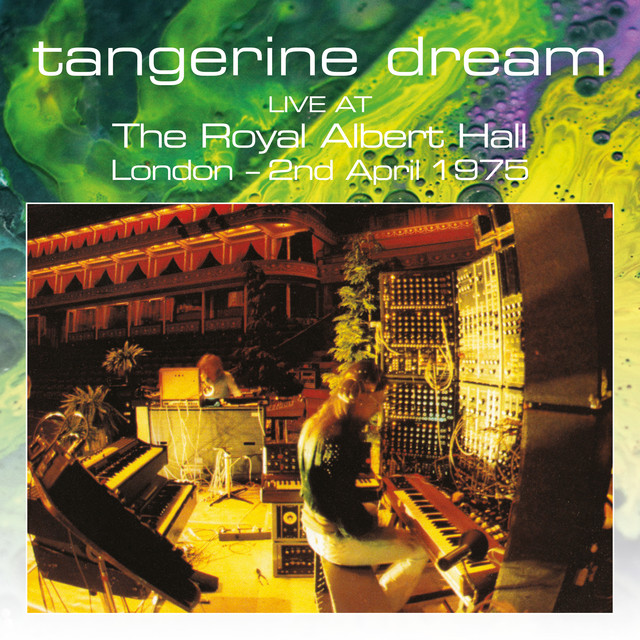
The other two London concerts, at The Rainbow Room and of course the Royal Albert Hall appearance, are connecting us more with the sound world we know from Phaedra and Rubycon perhaps, but here, too we have ample improvised compositions firmly rooted in a unique variant of space / ambient music that Tangerine Dream have unleashed on audiences well before ambient was called ambient...

In the fiery sequencer patterns we already hear elements of what Ricochet was to be, as a supreme example of Berlin School wizardry that stood the test of time. One can defy modular enthusiasts and sequencer magicians of 2019 to even replicate or emulate the astonishing sequencing present on these recordings from more than four decades ago.

The concert recordings show musicians achieving something in the 1970s that is rare even today, despite the mainstream position that some genres of electronic music occupy nowadays in major live performances and festivals. These live recordings are simply humbling: one has to clash with, and firmly realise, one's own limited human abilities, when trying to even follow the intricate multi-layered details swirlingly unleashed on us by these musicians.

Here we have largely improvised jams spanning, and seamlessly combining, distant corners of many different galaxies of electronic music. Actually playing multiple layers of intricate patterns emerging from fiendishly unstable analogue sequencers, instead of static repetitive patterns that many even now think sequencers are for? Of course, why not. Seamlessly blending spacey electronic atmospheres with gentle, almost fragile flutes and strings, piano textures and human voice? Of course, why not? Do taped strings pushed through phasers and modulated effects sit at home with pulsating Berlin School patterns of a very ordered and structured Universe? Sure.

Clearly, above is a far from exhaustive overview of the box set, but even if one omits mentions and reactions to the vast amount of musical material of this treasure chest, the Oedipus Tyrannus simply must be mentioned.

This is perhaps one of the, if not the, most mythical Tangerine Dream albums. It only existed in various unofficial forms, in highly variable (but consistently low) quality versions and it gained a mythical status not only due to these factors, but also because it contains a monumental electronic suite.

The epic material takes us from the avantgarde atmospherics of the Overture to the mind-blowing sequencers of the Battle to the playful melodic inventions of Baroque (latter actually being more of a Renaissance-era slow dance if one wishes to do nitpicking, when listening to the characteristic melodic lines). It further shows, as if there was any need, that Tangerine Dream has been and remains quintessential to the history of not just one genre or sub-genre of electronic music, but to the history of electronic music, full stop.

The range of music on just this box set shows how they have remained influential for vast arrays of electronic music ranging from most avantgarde and experimental ambient to the most mainstream sub-genres.

So what would be the single central characteristic of this vast collection of music released in this box set? Can one condense into a single word all the breathtaking and fiery improvisations, delicate and fragile melodic inventions, vibrations of star systems from distant outer space, waves and fluid motions of unidentifiable liquids, swirls and storms of strange aethers?

Most definitely, yes - and Tangerine Dream fans can put it down as nothing surprising, long-known by them and merely re-enforced by the proofs in this box set:

Imagination.