Showing posts with label ambient. Show all posts

Wednesday, 27 April 2022

The Master of sonic galaxies: R.I.P. Klaus Schulze


Klaus Schulze, a truly unique trailblazer, a relentless musical innovator with colossal discography filled with superhuman epic journeys through galaxies of sounds... has died on 26 April 2022. 

It is an over-used expression, but in His case, true to the letter: a unique mind, a unique spirit, a unique musician. To the very end, despite his colossal achievements, he remained charming, gentle, even self-parodising, with a lucid and stunningly honest view of his own artistic achievements.

My "first" was the impossible to describe or even grasp Timewind, when I was almost 14 - and it was something literally out of this world, it was like nothing ever heard or imagined to hear ever. It was the start of decades of excited discoveries. 

It was something that taught me: there is music that breaks every convention, every preconception - it just emanates from the fabric of the Universe, it surrounds you, it evolves and it cannot be poured into words chosen by a feeble ordinary human mind. One just had to surrender oneself to it and embark on a journey beyond journeys.

So a huge thanks for many decades of just superhuman meditations, of sound worlds that just came into being and evolved with myriad scintillating details. 

An era has ended - not just in electronic music. If Yannis Xenakis in his avantgarde and seminal Musique Formelle talked about galaxies of sounds, when modeling mathematically musical events, well, Klaus Schulze created those with pure human spirit and emotion.

He made impossible music possible - and instantly recognisable as something coming out of His studio, His mind. 

Even his collaborations are stellar, and out of this world. Who would have thought Lisa Gerrard's vocal improvisations will meet in something truly unique with the electronic Grand Master's improvisations? Or that Wolfgang Tiepold's phenomenal and heartfelt cello improvisations would blend with intricate electronics so well? And then we have Ash Ra Tempel, we have Tangerine Dream at the beginnings, to name just a few more giants of the musical landscape.

May He rest in peace and travel among unimaginable galaxies of sounds of a very special Universe he managed to give us glimpses of.


Sunday, 17 October 2021

Men, maths, and machines: Stochastic by Carbon Based Lifeforms


Stochastic music, as an actual term and method, really has its origins in Yannis Xenakis's seminal work from the 1960s, entitled Formalized Music (Musiques Formelles)

Essentially, random processes not only produce musical events in stochastic compositions, but they can be directed and/or constrained such that they can even create musical pieces of a certain style or genre. Creating a systematic mathematical treatise on this topic was an utterly groundbreaking move. 

Of course, in 2021, we have the luxury of looking back at decades of genuine computer music - i.e. musical works that were created not just on, but by computers. With the advent of personal computers, one could create such works at home, tinkering with stochastic processes or elaborate mathematical algorithms (for example, in the case of fractal music).

Computer compositions reliant on random elements were no longer confined to the laboratories with huge and terrifying looking computer monsters. Once upon a time, the stunningly human and mesmerising Illiac Suite could only be created on such a monstrosity, the ILLIAC computer at the University of Illinois.

Many have ventured into the realm of computer music, after all, even the ambient music luminary Brian Eno has built bridges between ambient and generative music.

We are almost at the end of 2021 now, and the ambient/psybient duo Carbon Based Lifeforms surprised fans by the release of an album called Stochastic

The album returns to the sonic world of their earlier ambiental albums like VLA and Twentythree.

The way in which this album was created is eminently different, though. Well, you may have guessed it, stochastic processes were applied in order to generate the sound sequences and textures. 

As the authors describe it, the tracks were born from exploiting the random features of some of their synths, and they were left alone to do their things... creating evolving textures, layers, and motifs. 

The track titles are firmly rooted in the world of maths and algorithms, apart from some poetic ones like Hello From The Children Of Planet Earth. Titles like Eigenvector, Finite State Space, Sphere Eversion are straight out of the world of vector algebra, control theory, and topology. 

One key aspect to highlight here is that the album does not contain what some may fear: these are not academic unlistenable experimentation, alien and alienating random sounds, or products of some purely theoretical adventure in areas of mathematics that nobody may understand. 

The album does sound remarkably identifiable as a CBL album. It has dreamy textures, floating layers of sonic bliss, and memorable evolving motifs. 

What is often forgotten when some discuss computer-generated music is that ultimately, it is still the human producing the end result. 

That human input may be merely a selection process of picking out pieces or entire tracks from the randomly generated output. It may be human involvement in the constraints imposed on the pseudo-random processes. It may be human control of numerous parameters, algorithms, stochastic processes. It may be human choices in the processing of the resulting sounds, e.g. via choices of effects.

Where the machine ends and where the human begins in computer-generated music is often a futile debate. 

We, as listeners are hearing the end result of a 'collaboration' between man and machine, where the machine was given more freedom than in normally composed and performed electronic music. 

When listening to Stochastic, at least this reviewer would recommend something perhaps scandalous to the listener: let's forget analysing where that delimitation line between the human crew of CBL and the synths may be. Let's not treat it as a highly technological record...

It is ethereal, pleasant, non-intrusive music but by no means for passive listening. There are endless details and myriad changes of subtle or tidal nature, there are tiny evolutions of sounds and there are vast swells of sounds. There are passages that are genuinely uplifting, expansive, and infused with what seems to be human emotions.

It comes across as a wholly enjoyable, varied, and quite human album. 

As Bill Laswell once wrote, Computers and electronic music are not the opposite of the warm human music. It's exactly the same...


Sunday, 8 August 2021

Returning from turbulent seas: Paul Haslinger's Exit Ghost II


Being an influential member, even if temporarily, of a legendary band with individual voice in the global music landscape can affect later on the way in which the band's fans react to one's solo albums... especially when those significantly depart from what is "expected" by those fans. 

If a band is as long-lived and influential as Tangerine Dream is, then its ex-members' solo efforts inevitably get compared by fans, and not just, to the style and sonic universe of the TD albums from various eras. 

When Christopher Franke released his highly visual, descriptive (thus, in classical terms, program) music on his first solo album (Pacific Coast Highway), there were not only ovations... but also dismay from some. It was not "like TD". It was "disappointingly" not TD. 

Paul Haslinger, another notable name in Tangerine Dream history, has quite a few soundtrack, solo, and collaborative albums under his belt. Even so, his fragile, almost translucent, ethereal album Exit Ghost stunned some - not in a positive way. It was a radical departure not only from TD, but also from his own previous creations... 

Probably similar things happen with the new album, Exit Ghost II... One can always judge a composer by the musical range he/she is capable of (even if one is not subjectively enjoying some segments of that range), or one can just judge it by comparisons with what is "expected". In latter case, it seems useful to provide a very early hint to those listeners - and let them know that this album, too is a radical departure from "expected" TD-like music. 

Its predecessor was born under exceptional circumstances - and this sequel comes just when the world is trying to return from the lengthy shock that was Covid's arrival. 

To quote, the album was "born out of an incessant need to escape the trauma that has gripped the world for the last year coupled with an urge to complement the introspective and moody atmospherics of the last record, ‘Exit Ghost II’ is the counter-element that closes the circle".

The very first things to remark is that it does have a wider sonic range, with even orchestral textures - it does feel more luminous and emotionally charged. However, it still has that sublime quality that we heard on the first album, and entire passages of it can only be compared to the gentle, remarkably introspective soundscapes we hear on Ryuichi Sakamoto's Async or many Olafur Arnalds albums. 

Cambium, the opening track does place us in the minimalist, charming, piano- and electronic percussion-based Universe we may hear on Arnalds albums. Other piano-centric tracks like Septuagint are playful, adventurous, this particular one playing with 7/8 time signature that is refreshing to hear after so many metric tonnes of firmly 4/4-based electronic music...

Emerald is an example of the ethereal beauty Haslinger can conjure from some floating electronic textures and a few perfect gems of piano motifs. Translucent, exactly as the title suggests, is another example, where choral sounds are at the same time Earth-bound and otherworldly. 

Waltz II and Inversion III return us to a piano-based sonic world, with the former bringing lovely melancholy, while the latter moving out into more experimental-sounding chromaticism.

Mishkin has again an ethereal feel that can be perhaps described as something that Thomas Newman fans would love: fragile, translucent textures punctuated by gentle piano chords. So is Schubert IX Coda, which combines infinitely delicate electronics with subtle piano notes and chords.

The closing track, A Young Fellow is not only standing out with its rich orchestral feel, but it is also charming with its use of voice samples - and overall an uplifting, optimistic ending to the album.

As the notes of the album state, Paul Haslinger’s ‘Exit Ghost II’ is the composer’s quest for arrival after a year lost at sea. 

After a bizarre and in many ways dark, anxiety-permeated year, this follow-up album, ending with aforementioned uplifting track filled with optimism, is really a successful antidote to 2020's dark clouds...


Tuesday, 30 June 2020

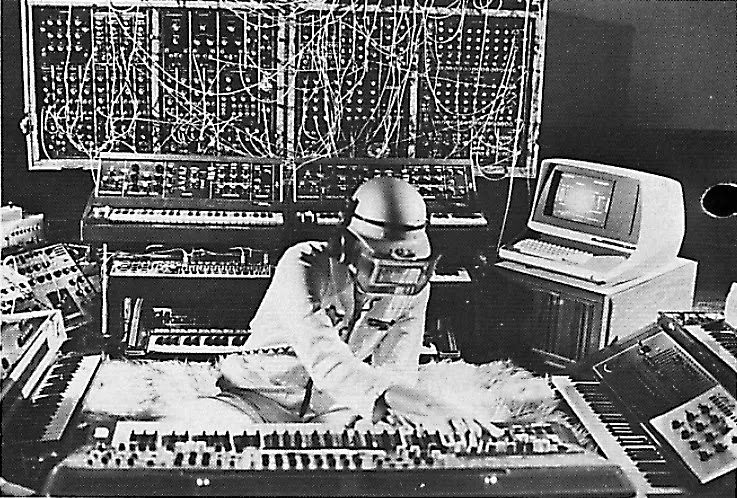
Fifty Years Of Unique Audentity: Klaus Schulze


Borrowing the pun of one of his landmark double albums, it seems fitting on the last day of June to look at the vast body of work of one of the most individual electronic music visionaries of our times, someone with a very unique and instantly audible identity... pardon, audentity...

In June 1970, the first album appearance of Klaus Schulze occurred. At that point he was a member of what has become a veritable institution in the electronic music sphere: the band Tangerine Dream, founded by the late Edgar Froese.

Electronic Meditation was the first and last Tangerine Dream album that featured Schulze - as he promptly moved on to establish his, by now legendary, solo career. 

Audiences may not have suspected at that time that the drummer, who joined Tangerine Dream after a brief and unreleased musical contribution in the rock band Psy Free, would become a unique and vastly (seldom successfully) imitated electronic music luminary.

His early solo albums, Irrlicht and the double LP Cyborg, presented us a daringly and unashamedly experimental musician who could conjur up entire strange worlds in as long as possible continuous compositions. Back then, the physical medium only allowed twenty-odd minutes of continuous sonic poetry... but the later Klaus Schulze of the CD era could mesmerise us with seventy-plus minutes long monumental electronic structures...

Well before "trance" entered the terminology of music, and well before it has become a label for a particular sub-genre of electronic music, Klaus Schulze was creating an unmistakeably personal and truly unique kind of electronic trance.

One could pick from his vast discography the hypnotic Timewind and Mirage from the heroic and analogue 1970s, the astounding Audentity or En=Trance from the confident and digital 1980s, the spellbinding Das Wagner Desaster or In Blue of the mature and limitless 1990s... or the epic, but intimate, Rheingold or Silhouettes of the recent years...

The one central trait of all Schulze albums has been a rare, much sought-after, and countless times attempted to be imitated feeling that this music simply comes into being, without someone playing electronic or other instruments... and it exists, flows, occupies all available space without any human intervention.

It is impossible to listen to Klaus Schulze as background electronic music. Whilst he was and is recognised as a giant of the sequencer-oriented Berlin School of electronica, Schulze's music demands close attention.

Even if, on the surface, repetitive structures or sequenced elements are present, they are full of continuously changing, morphing, flowing myriad details. The intricacies of his live or studio performances are dazzling, if one closely listens to the ever-changing sonic Universe he achieves to create in our room. 

Over the fifty years, Schulze has never stopped innovating and changing. Sure, some artistic decisions could be seen as questionable or one could point out major U-turns in his ars poetica.

The key aspect one must not forget is that artists like Schulze have experimented with sometimes wild departures in highly unexpected directions, instead of standing still. We may wish that we had been treated to countless repetitions of Timewind and we may go misty-eyed when thinking nostalgically of the musical world of Dune or X

However, as in the case of Tangerine Dream, one has to realise that instead of self-repetition, such artists were daring enough to constantly seek out new directions, experiment with even never before touched technologies, and move with the times - or, actually, define those times. 

He has treated us to superhuman-looking and -sounding live improvisations, impossible to dissect and mind-blowingly complex whirls and galaxies of sequencer patterns, vast floating sonic ambiences before ambient music became a term, trance-inducing grooves before trance music became a term, imaginative and daring use of sampling, collaborations with legendary musicians as far from electronica as one could possibly imagine... Who would have thought the legendary  Lisa Gerrard's vocal improvisations would perfectly and astonishingly blend in with Schulze's vast sequenced structures in a live setting, too?... 

It might be impossible for an avid electronic music, or even Klaus Schulze, fan to like all his live and studio albums... However, the one constant we can easily hear on his albums, irrespective of the fundamentally different sound worlds he has experimented with over half of a century, is that Schulze sound...

What is it exactly? The long flowing compositions? The mind-bendingly complex and constantly shifting sequencer work? The superhuman improvisations running through the fluid soundscapes? The seamless combination of ancient sonorities, even ethnic vocals, ocean-deep sonic textures, and fiery improvised leads?


Even after fifty years of album releases, one cannot be sure... but as soon as previously unknown to me Schulze album or composition popped up on radio or elsewhere, I used to jump: that had to be Schulze!.. and it was.

If there was one person who would, not too strong of a word, hate pigeonholing his vastly varied musical output, it would be Schulze himself. 

As the grand master put it in a recent interview, "Remember ‘fusion’ once? Or ‘jazz rock’? And in 1990 it was for some parts of electronic music ‘acid’, ‘acid jazz’, ‘house’, ‘deep house’, ‘Detroit techno’, ‘rare groove’, ‘New York garage’, ‘industrial’, ‘Latin hip hop’ et cetera. All these fashionable coming-ups of words are not the terms and definitions I think or care much about. I am neither a swish sociologist nor a smart journalist but just a dull little musician who’s doing and enjoying his very own doings, and I call it ‘music’.”

Thus... thank you for fifty years of live and studio albums of music, Maestro... and may we be spoiled by further sonic creations in the future...



Wednesday, 6 June 2018

Silhouettes - a perfectly titled new Klaus Schulze album


Quite a few years have passed since the last Klaus Schulze studio album, if we don't count renamed re-releases of material that essentially has seen the light as Contemporary Works Vol. I and II.

Silhouettes is perhaps his most introspective and calm album for some time, and as some have commented on the almighty internet that it is "disappointing", perhaps it is useful to first enumerate what we do not find on this album.

There are no hour-long multi-layered jams, no fiery Moog solos, no sampled phrases leaping at us at any moment, no high-octane sequenced percussion grooves, not even high-octane sequencer runs... No world music-esque Middle or Far-Eastern vocals, no cello or other instrumental improvisations.

So expectation management aside, what does one find on the new album?

It is a quite balanced affair. Four concise pieces of 15-to-20-odd minutes length lend to the album a structural balance, too.

Each piece has a construction that takes us from a calm exposition to a more dynamic part with Berlin School characteristics, and then to a calm conclusion.

The title track is quite fitting, as the lush pads create a pleasant and atmospheric sonic mist, in which the gently introduced sequencer patterns never dominate - they just sparkle and shine through this mist, with subtle touches and variations.

Chateaux Faits de Vents, or Castles Made Of Winds, continues this airy feel, we get an atmospheric intro with the instantly recognizable pad sounds and chord changes... and it leads to a mid-section with gentle sequencer patterns. The variations are subtle and perfectly suited for a meditative listening, we are not treated to any sudden moves or unexpected turns.

Der Lange Blick Zuruck, or The Long Look Backward, is similar in terms of its structure and the characteristics of the sequenced layers in its middle part. The choral sounds before and after the scintillating metallic sequenced parts are giving this track, too a quite ethereal feel.

In some ways, one could say that the sequencer work on these tracks is sharing some DNA with the floating, fluid, sparkling motif that returns from time to time in the track Sebastian im Traum, on the double album Audentity.

Quae Simplex, or That Simple, is the most energetic track - not just in its opening, as this is the only piece that starts with confident sequencer lines, but also in the fact that it contains classic and non-sequenced sounding drumming, which is jamming along the layers of sequenced motifs. In many ways, this is the track that looks back to an earlier sound and style - we can think of the '70s Schulze studio and live releases that featured drum tracks of this type.

There is, though, a stronger similarity at work on this album and it may be contributing to some of the more negative takes seen so far.

In its gentle layers and soft sequences, it reminds us in a very nice way of the feel of the double album In Blue for instance, or the more introspective parts of aforementioned Contemporary Works.

However, the similarities with the sequencer work on Shadowlands or Big in Europe are surprisingly, perhaps even too, strong. Down to the actual patterns we hear, the sounds they trigger and the time signatures, it really gives a strong deja-vu, or deja-entendu, feel from just few years ago. In some parts we may have the feeling that certain sequencer lines were straight transplanted from another album's sonic layers and even kept the same synthesizer patch selections for them.

However, if one dissects it too much, it ruins the overall feel and imagery of the album... so if one is bothered by these very strong similarities, perhaps best to treat the album as a standalone venture into a calmer, contemplative realm that we have not really heard from grand master Schulze for many years.

In that respect, it is one of the best and most comforting, gentle albums he's ever made.

It is, hopefully, not overstating that one hopes the great Berlin School master will continue treating us to many more such polished and confidently beautiful albums in the future.


Tuesday, 3 April 2018

A subtle but epic journey: Ourdom by Solar Fields


It is safe to say that by now one can firmly expect Solar Fields albums to have impeccable production, delicate care taken in sound design, subtle details in the mix and no self-indulgent technological showing off.

Ourdom, the very recent release by Magnus Birgersson aka Solar Fields is no exception - but apart from the polished technical elements, the musical aspects of the just-under 80-minutes-long album don't let expecting fans down either.

In today's collapsing attention span, shrinking to almost a singularity, it is quite uplifting to see an artist trusting us with well-structured, seamlessly flowing long pieces in the vein of the epics by Klaus Schulze.

Burning View, the album's opening track, is gently introducing the epic musical adventure with a floating ambience and subtle sonic ornaments. The gradual transition to solemn piano chords in Shifting Nature, then to the anthemic uplift of Into The Sun is a typical and very satisfying Solar Fields construct.

One can fully expect to be gradually taken to climaxes like Mountain King and Moving Lines, which are high-octane, but perfectly economically done EDM pieces with imaginative changes and variations.

Tracks like Wave Cascade provide a repose and a chance for introspection between the energetic currents of the aforementioned tracks, and Ourdom is very capable of shifting us between inner states as it does so with musical epochs, too...

Joshua's Shop with its ascending playful notes is taking us from electronic ambiences to a classical period, when the first glassy harp-like notes appear... As a delicate, nostalgic and exquisitely economic piece, it again shows how sound design, musical elements and thinking in structures can produce a concise and evocative sonic picture.

If one was not convinced by the range of imaginings heard so far, then A Green Walk and Parallel Universe can show us how eminently ambient atmospherics and spacey harmonies can fit in with the more soaring and driven passages of the album.

One can appreciate in some perfectly put-together long mixes the way in which different moods and tempos can be combined into a whole sonic journey, the mix becoming greater than the sum of its parts.

However, to state the obvious, here we have original material composed of 13 tracks, each seemingly conceived to be organic parts of the greater unit: just inspect closely the subtle way in which musical elements of a track can reference other sections they build up from or dissolve into...

It is a rare treat, and in a rushing world it is perhaps outrageous to strongly emphasise that Ourdom is best enjoyed, due to above reasons, as a single musical journey - and not track by track. Having said that, each track perfectly functions on its own, and, again, in typical Solar Fields fashion, each is a little electronic gem.

The album flows and connects very distant moods, from pure atmospherics to playful melodies to energetic motions, but the transitions are never with harsh edges...

On Ourdom, there are no right angles nor sharp edges, only ascending and descending waves and curves...


Saturday, 7 October 2017

Carbon Based Lifeforms...far from Derelicts


After a prolonged break (with the exception of some notable remastered versions of earlier albums), the categorisation-defying Swedish duo Carbon Based Lifeforms is back in full force.

Indeed, with their discography rooted in the more "ambient" side of the electronic music spectrum, but nevertheless often offering eminently head-bobbing-inducing tracks, too, one could wonder what the announced album Derelicts would sound like.

Instead of a departure into some stereotypical electronica, Derelicts is a 12-track album of quite some integrity and instantly recognisable as a CBL creation.

While Accede opens the album with that characteristic sound and patient development of hypnotically repetitive textures and sequences, CBL fans will be glad to encounter later on quite a variety of moods and tones...

Parts of Clouds or Nattvรคsen have references to, and echoes of, sound worlds first heard on World of Sleepers and Twentythree.

Equilibrium has that slow and rather irresistibly hypnotising rhythm one may have heard on the album Hydroponic Gardens.

The title track is really a stand-out piece, CBL at their most majestic and flowing at the same time, with deceptively simple, but anthemic, melodic progression lifting the track after its ambiental beginnings.

For a more abstract and eminently ambient sonic trip, Path of Least Resistance is a keeper - with a vast sonic landscape that reminds one of VLA and Twentythree.

One does not stop being amazed by the sense of melancholy mixed with majestic electronic soundscapes that CBL can infuse tracks with: ~42° is a perfect example of how the by now characteristic sonic elements are blended seamlessly by the electronic duo.

The structure of the album is also quite noteworthy, the soaring, uplifting tracks frame very nicely the quieter ambient works, plotting quite well a sonic journey through different states.

For example, 780 Days returns to the energetic opening sections of the album and lifts us out of the reverie, but there are no harsh edges and no sudden transitions - everything, as any CBL fan would rightly expect, flows very nicely.

Similarly, Rayleigh Scatterers and Dodecahedron provide melodic laid-back repose between more introspective tracks.

The mastering job done on the album is of a quality one would expect, the thunderous bass and percussion in tracks like 780 Days sit very well with the subtle and very refined ambient sonic elements.

This makes the album feel quite dreamy and light in places, even when the actual electronic sound palette is darker and more ominous.

CBL have found a very rare and specific register, like an elusive and mythical register on a mighty organ: Derelicts is, again, an eminently electronic album where technology does not take over, but from shaping subtle quasi-transparent constructs to processing sounds of thundering echoes of vast spaces, technology serves the artistic intent.

The result is, once again, a sonic world with a very personal touch and without the faintest sign of wanting to get lost in any commercial trend of electronica, whichever has been raging out there, outside the CBL sonic Universe, during the years that passed since the Refuge soundtrack album.

As the duo have reported in the recent past, the album would have been shorter but in its last creative stages suddenly a new track was born that simply had to be included on what has become a 12-track album in the end.

Overall, zero shortage of imagination again, and while keeping eminently characteristic CBL sound going through the entire album, there are no direct self-references - hence Derelicts feels thoroughly fresh.

It is a huge relief, that with the so-called "revolutions" (i.e. regurgitations of decades-old electronic music genres and style) like synthwave and such, some names keep looking forward instead of backward - and look at technology as a tool for creating new sonic visions (as contradictory as the term may sound).


Saturday, 5 August 2017

Schulze at 70


Klaus Schulze, one of the true godfathers of electronic music, has just turned seventy.

Anybody permanently affected, in the best possible sense, by his truly unique style of synth music output spanning fifty years, can only wish a very Happy Birthday to the  maestro and many more to come...

From the heroic early days of Tangerine Dream collaboration in the late '60s to the similarly heroic, and still landmark value, solo albums like Irrlicht and Cyborg, Klaus Schulze's musical journey has given us many changes in musical direction and style, many philosophical changes...

However, his style has remained instantly recognisable - and very few dared to maintain his courage of creating ever-evolving tracks that most often occupy the full length of the physical medium. Compositions of 70 minutes length are far from unusual in the world of Klaus Schulze...

Like with any artist of astonishingly long career, some philosophical changes in direction have been questionable. Some may recall how the "death" of analogue synths was announced in a resounding album title, then later to see a superb return to that technology... or how a certain period was marked by an abundance of samplers that, even in the artist's own admission, took him away from a truly personal voice.

Apart from such escapades, the relentless innovation and experimenting has been a hallmark of his vast discography. He started as drummer and perhaps, as in the case of the other sequencer wizard, Chris Franke of Tangerine Dream, helped him to have a quite different approach to sequencers...

His precise command of intricate, multi-layered, mind-bendingly ever-evolving sequences has led to what became one of the key ingredients of his compositions that made the latter stand out compared to the rather traditional and mechanical use of sequencers.

Even when blending into his music Eastern vocals, operatic voice, cello improvisations, or Lisa Gerrard's truly unparalleled vocal improvisations, there has always been one key feature of his music that even other heralded "ambient" or "space" music artists did not manage to achieve.

No matter how vast the soundscapes are in length and complexity, not only there is something always changing every few seconds, making it a truly mind-blowing experience on a closer listen, going behind the sometimes hypnotically repetitive passages... but... and it is a huge "but":  Klaus Schulze has established a type of electronic music that seems to happen on its own...

When listening to his varied output, one does not get the feeling that this is electronic music that is created and performed by someone, with the exception of his fiery Moog improvisations...

It is music that seems to emanate on its own, and fold and change every few seconds, without humans and instruments actively creating it. Think of the landmark that was Timewind... still as mind-blowing now as it was in 1975.

Not that this dehumanises his music - not at all, for that we need to look at the eminently different Kraftwerkian school where technology takes over and this in itself is central and intentional in its aesthetic.

Klaus Schulze's perhaps greatest achievement is that he created for half a century an eminently human, passionate, deep "space" music that makes us disconnect from the practicalities and thoughts related to the mechanics of how this music is created.

It just exists and evolves, taking us on vast journeys that any amateur, professional or long-time established star of "ambient", "space" etc. genre should still learn from - after many decades of listening to these genres, one can argue there really is no other person out there who comes close to creating the worlds that Klaus Schulze created and still creates.

Therefore... even more emphatically, many many happy birthdays Maestro!