Showing posts with label Klaus Schulze. Show all posts

Wednesday, 27 April 2022

The Master of sonic galaxies: R.I.P. Klaus Schulze


Klaus Schulze, a truly unique trailblazer, a relentless musical innovator with colossal discography filled with superhuman epic journeys through galaxies of sounds... has died on 26 April 2022. 

It is an over-used expression, but in His case, true to the letter: a unique mind, a unique spirit, a unique musician. To the very end, despite his colossal achievements, he remained charming, gentle, even self-parodising, with a lucid and stunningly honest view of his own artistic achievements.

My "first" was the impossible to describe or even grasp Timewind, when I was almost 14 - and it was something literally out of this world, it was like nothing ever heard or imagined to hear ever. It was the start of decades of excited discoveries. 

It was something that taught me: there is music that breaks every convention, every preconception - it just emanates from the fabric of the Universe, it surrounds you, it evolves and it cannot be poured into words chosen by a feeble ordinary human mind. One just had to surrender oneself to it and embark on a journey beyond journeys.

So a huge thanks for many decades of just superhuman meditations, of sound worlds that just came into being and evolved with myriad scintillating details. 

An era has ended - not just in electronic music. If Yannis Xenakis in his avantgarde and seminal Musique Formelle talked about galaxies of sounds, when modeling mathematically musical events, well, Klaus Schulze created those with pure human spirit and emotion.

He made impossible music possible - and instantly recognisable as something coming out of His studio, His mind. 

Even his collaborations are stellar, and out of this world. Who would have thought Lisa Gerrard's vocal improvisations will meet in something truly unique with the electronic Grand Master's improvisations? Or that Wolfgang Tiepold's phenomenal and heartfelt cello improvisations would blend with intricate electronics so well? And then we have Ash Ra Tempel, we have Tangerine Dream at the beginnings, to name just a few more giants of the musical landscape.

May He rest in peace and travel among unimaginable galaxies of sounds of a very special Universe he managed to give us glimpses of.


Tuesday, 30 June 2020

Fifty Years Of Unique Audentity: Klaus Schulze


Borrowing the pun of one of his landmark double albums, it seems fitting on the last day of June to look at the vast body of work of one of the most individual electronic music visionaries of our times, someone with a very unique and instantly audible identity... pardon, audentity...

In June 1970, the first album appearance of Klaus Schulze occurred. At that point he was a member of what has become a veritable institution in the electronic music sphere: the band Tangerine Dream, founded by the late Edgar Froese.

Electronic Meditation was the first and last Tangerine Dream album that featured Schulze - as he promptly moved on to establish his, by now legendary, solo career. 

Audiences may not have suspected at that time that the drummer, who joined Tangerine Dream after a brief and unreleased musical contribution in the rock band Psy Free, would become a unique and vastly (seldom successfully) imitated electronic music luminary.

His early solo albums, Irrlicht and the double LP Cyborg, presented us a daringly and unashamedly experimental musician who could conjur up entire strange worlds in as long as possible continuous compositions. Back then, the physical medium only allowed twenty-odd minutes of continuous sonic poetry... but the later Klaus Schulze of the CD era could mesmerise us with seventy-plus minutes long monumental electronic structures...

Well before "trance" entered the terminology of music, and well before it has become a label for a particular sub-genre of electronic music, Klaus Schulze was creating an unmistakeably personal and truly unique kind of electronic trance.

One could pick from his vast discography the hypnotic Timewind and Mirage from the heroic and analogue 1970s, the astounding Audentity or En=Trance from the confident and digital 1980s, the spellbinding Das Wagner Desaster or In Blue of the mature and limitless 1990s... or the epic, but intimate, Rheingold or Silhouettes of the recent years...

The one central trait of all Schulze albums has been a rare, much sought-after, and countless times attempted to be imitated feeling that this music simply comes into being, without someone playing electronic or other instruments... and it exists, flows, occupies all available space without any human intervention.

It is impossible to listen to Klaus Schulze as background electronic music. Whilst he was and is recognised as a giant of the sequencer-oriented Berlin School of electronica, Schulze's music demands close attention.

Even if, on the surface, repetitive structures or sequenced elements are present, they are full of continuously changing, morphing, flowing myriad details. The intricacies of his live or studio performances are dazzling, if one closely listens to the ever-changing sonic Universe he achieves to create in our room. 

Over the fifty years, Schulze has never stopped innovating and changing. Sure, some artistic decisions could be seen as questionable or one could point out major U-turns in his ars poetica.

The key aspect one must not forget is that artists like Schulze have experimented with sometimes wild departures in highly unexpected directions, instead of standing still. We may wish that we had been treated to countless repetitions of Timewind and we may go misty-eyed when thinking nostalgically of the musical world of Dune or X

However, as in the case of Tangerine Dream, one has to realise that instead of self-repetition, such artists were daring enough to constantly seek out new directions, experiment with even never before touched technologies, and move with the times - or, actually, define those times. 

He has treated us to superhuman-looking and -sounding live improvisations, impossible to dissect and mind-blowingly complex whirls and galaxies of sequencer patterns, vast floating sonic ambiences before ambient music became a term, trance-inducing grooves before trance music became a term, imaginative and daring use of sampling, collaborations with legendary musicians as far from electronica as one could possibly imagine... Who would have thought the legendary  Lisa Gerrard's vocal improvisations would perfectly and astonishingly blend in with Schulze's vast sequenced structures in a live setting, too?... 

It might be impossible for an avid electronic music, or even Klaus Schulze, fan to like all his live and studio albums... However, the one constant we can easily hear on his albums, irrespective of the fundamentally different sound worlds he has experimented with over half of a century, is that Schulze sound...

What is it exactly? The long flowing compositions? The mind-bendingly complex and constantly shifting sequencer work? The superhuman improvisations running through the fluid soundscapes? The seamless combination of ancient sonorities, even ethnic vocals, ocean-deep sonic textures, and fiery improvised leads?


Even after fifty years of album releases, one cannot be sure... but as soon as previously unknown to me Schulze album or composition popped up on radio or elsewhere, I used to jump: that had to be Schulze!.. and it was.

If there was one person who would, not too strong of a word, hate pigeonholing his vastly varied musical output, it would be Schulze himself. 

As the grand master put it in a recent interview, "Remember ‘fusion’ once? Or ‘jazz rock’? And in 1990 it was for some parts of electronic music ‘acid’, ‘acid jazz’, ‘house’, ‘deep house’, ‘Detroit techno’, ‘rare groove’, ‘New York garage’, ‘industrial’, ‘Latin hip hop’ et cetera. All these fashionable coming-ups of words are not the terms and definitions I think or care much about. I am neither a swish sociologist nor a smart journalist but just a dull little musician who’s doing and enjoying his very own doings, and I call it ‘music’.”

Thus... thank you for fifty years of live and studio albums of music, Maestro... and may we be spoiled by further sonic creations in the future...


Tuesday, 31 July 2018

Presets - the good, the bad, the clichéd


When it comes to various forms of purism or certain dogmatic views, music production is by no means special among the creative activities of various art forms.

One can find strong analogies between music and photography, for instance, when it comes to gear-related irrational claims and views. In other cases, when elements of the creative workflow are massaged into sweeping generalisations, one can go further...

Such is the case of famous, infamous or just everyday presets... We take them for granted, as nowadays synthesizers with memory, or those assisted by external gadgets, allow instant recall of a set of parameters in order to recreate specific sounds created by the instrument manufacturers' sound designers.

As everything in the field of electronic instruments, presets, too have been elevated from their merely utilitarian role in music production to the level of vehement, philosophical-sounding, and at their core always self-asserting, statements. However, many of the latter actually build on self-contradicting fallacies - and in terms of a cognitive process, it is fascinating how the most boundless music genre and its by now virtually limitless technology can produce the narrowest views so often...

Hence we see and hear numerous statements along the lines of:

1. "I never use presets" 

It is quite commendable to only rely on one's own sonic creations, however, as much as this wants to sound superlatively creative in all its fervour, it ironically disregards many nuances of the creative process and its objectives.

Bach never rolled up his sleeves to produce a prepared version of his harpsichord, nor attacked church organ pipes and valves with various blunt or sharp tools, nor did Debussy go on Cage-like adventures inside his piano... but... it would be ludicrous to attempt to make the point that somehow they were not "truly" creative in producing evocative soundscapes. Stravinsky's landmark The Rite of Spring is quite a juxtaposition of, well, presets... so is Terry Riley's seminal In C

Ergo they were not as creative as an electronic musician constantly going on about "never using presets" in his studio... ? After all, latter musician has the luxury of creating and/or using any sound imaginable, while mentioned gentlemen were confined to pre-defined sounds of their instruments - but this is where the "can" transforms into a "must" and becomes a tool in self-aggrandizment.

Many of the biggest names of the electronic music genre, too were and are perfectly happy to employ presets, as the latter may well be the most perfectly fitting sounds for the piece they envision.

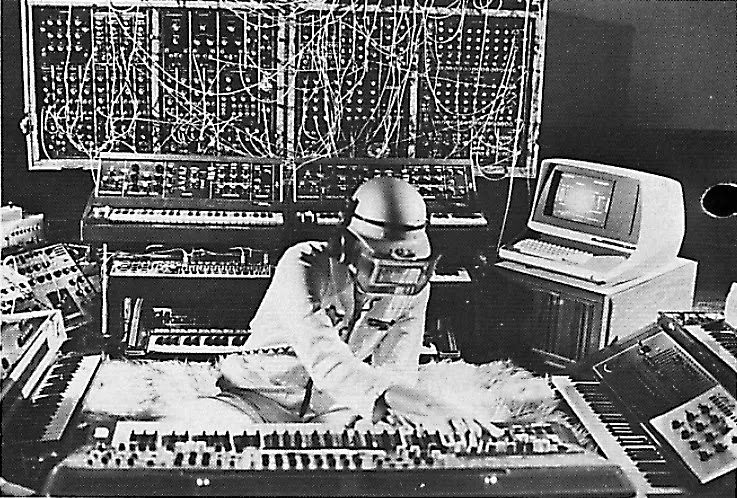
Klaus Schulze - a vintage jam session
It would be pointless to count how many Yamaha CS-80 presets occur in the classic Blade Runner soundtrack by Vangelis, as it is virtually entirely built from preset sounds..

Nor would it help counting how many presets have the grand masters and pioneers like Klaus Schulze or Tangerine Dream used - as there were countless.

Ultimately, it is about the sound - and how it fits and/or expresses what the creator imagined. Did that sound come from a factory preset or from a custom setting created from scratch? Well, does it actually matter, if it fits what the creator wanted in the end result? 

Does the use of cobalt blue or cadmium yellow make a painter less creative as he/she may have employed them as is, without personalised alterations of the colour tone? 

Would we call Turner's skies relying on standard cobalt blue less creative? Certainly Van Gogh must have been a hack for employing plain cobalt blue as a cheaper option to the (then) horridly expensive natural ultramarine...


2. "That piece used some very cliché presets"

Indeed, some instruments had and have "killer" presets that have been (over-)used with wild abandon by many. We can all come up with considerable lists of such sounds across the decades of electronic music, and perhaps the '80s and '90s are the most guilty decades... 

Going back to the essence of the creative process, the fundamental question is whether the perhaps clichéd sound works. 

To go to a painting analogy again, Raphael and Vermeer, to name just two painters, have made quite some use of natural ultramarine - which was, already well before they made use of it, a quite expensive colour cliché, a mighty "preset" on the colour palette. 

Does Raphael's Madonna strike us as a boring cliché because of the use of natural ultramarine? Yes, a clearly rhetorical question... and there can be countless similar ones.


3. "I always start from scratch"

It is another version of "I never use presets", but it emphasizes the labour that takes one from a moment of sonic inspiration to the moment of recording the imagined or just improvised sound. 

If one over-emphasizes this process, then one actually disregards (at best) or belittles (at worst) entire alternative creative workflows that may not work for that person, but they work splendidly well for other artists.

Once again, the ego is at work instead of reason and balance in creative choices. 

Schulze's seminal Timewind, which led to the grand prize of  the Académie Charles-Cros, was put together in a bedroom session and although it used modular gear, too, it certainly didn't start with a blank setup. Nor did many of his and his contemporaries' spellbinding studio or live sessions...

Many era-defining pieces and entire albums by Vangelis were put together in improvised sessions, not seldom in single takes especially after the availability of his custom-built so-called Direct boxes.

Heavily improvisation-based works have started from a lot more than a cleaned-up modular setup or wiped sound banks... and often their unparalleled strength lies in their spontaneity that relied on readily available and easily switchable presets.


The problem with many of these over-stated and over-emphasised heroics implied in "not using presets" is that they are meant as emphases on the self-perceived value of the end result, and often as qualifying statements of one's own creativity. 

Alas, these grand statements achieve quite the opposite - as an interesting inverse correlation can also demonstrate. See how often defining names of the genre go on and on about their refusal to use presets (or about any other rigid preconceptions for that matter when it comes to the creative process) - compared to budding electronic musicians doing the same in myriad internet forums...


Wednesday, 6 June 2018

Silhouettes - a perfectly titled new Klaus Schulze album


Quite a few years have passed since the last Klaus Schulze studio album, if we don't count renamed re-releases of material that essentially has seen the light as Contemporary Works Vol. I and II.

Silhouettes is perhaps his most introspective and calm album for some time, and as some have commented on the almighty internet that it is "disappointing", perhaps it is useful to first enumerate what we do not find on this album.

There are no hour-long multi-layered jams, no fiery Moog solos, no sampled phrases leaping at us at any moment, no high-octane sequenced percussion grooves, not even high-octane sequencer runs... No world music-esque Middle or Far-Eastern vocals, no cello or other instrumental improvisations.

So expectation management aside, what does one find on the new album?

It is a quite balanced affair. Four concise pieces of 15-to-20-odd minutes length lend to the album a structural balance, too.

Each piece has a construction that takes us from a calm exposition to a more dynamic part with Berlin School characteristics, and then to a calm conclusion.

The title track is quite fitting, as the lush pads create a pleasant and atmospheric sonic mist, in which the gently introduced sequencer patterns never dominate - they just sparkle and shine through this mist, with subtle touches and variations.

Chateaux Faits de Vents, or Castles Made Of Winds, continues this airy feel, we get an atmospheric intro with the instantly recognizable pad sounds and chord changes... and it leads to a mid-section with gentle sequencer patterns. The variations are subtle and perfectly suited for a meditative listening, we are not treated to any sudden moves or unexpected turns.

Der Lange Blick Zuruck, or The Long Look Backward, is similar in terms of its structure and the characteristics of the sequenced layers in its middle part. The choral sounds before and after the scintillating metallic sequenced parts are giving this track, too a quite ethereal feel.

In some ways, one could say that the sequencer work on these tracks is sharing some DNA with the floating, fluid, sparkling motif that returns from time to time in the track Sebastian im Traum, on the double album Audentity.

Quae Simplex, or That Simple, is the most energetic track - not just in its opening, as this is the only piece that starts with confident sequencer lines, but also in the fact that it contains classic and non-sequenced sounding drumming, which is jamming along the layers of sequenced motifs. In many ways, this is the track that looks back to an earlier sound and style - we can think of the '70s Schulze studio and live releases that featured drum tracks of this type.

There is, though, a stronger similarity at work on this album and it may be contributing to some of the more negative takes seen so far.

In its gentle layers and soft sequences, it reminds us in a very nice way of the feel of the double album In Blue for instance, or the more introspective parts of aforementioned Contemporary Works.

However, the similarities with the sequencer work on Shadowlands or Big in Europe are surprisingly, perhaps even too, strong. Down to the actual patterns we hear, the sounds they trigger and the time signatures, it really gives a strong deja-vu, or deja-entendu, feel from just few years ago. In some parts we may have the feeling that certain sequencer lines were straight transplanted from another album's sonic layers and even kept the same synthesizer patch selections for them.

However, if one dissects it too much, it ruins the overall feel and imagery of the album... so if one is bothered by these very strong similarities, perhaps best to treat the album as a standalone venture into a calmer, contemplative realm that we have not really heard from grand master Schulze for many years.

In that respect, it is one of the best and most comforting, gentle albums he's ever made.

It is, hopefully, not overstating that one hopes the great Berlin School master will continue treating us to many more such polished and confidently beautiful albums in the future.


Saturday, 3 March 2018

Converging worlds, stable antagonisms

Famously, and somewhat infamously, Klaus Schulze's first fully digital recording Dig It proclaimed the "death of an analogue" in one of its tracks.

Although the lyrics were ironic, and digital was understandably called an "automat" at that time, 1980 was not quite the best moment for heralding a tectonic shift toward an exclusive relationship with the emerging digital instruments.

Eminently digital synths (from early samplers to the later FM synths and beyond) have expanded the sonic palette to before unimaginable dimensions - but when it came to an "analogue" sound, they had been operating with a couple of crucial limitations.


In terms of sound synthesis and processing, the available computational power  was one of the factors that had been limiting the bit resolution and sample rate of the digitally represented signals that the synth operated with. This then introduced sonic artifacts, e.g. the especially notorious aliasing and a puny performance of early digital filters. Many of the still surviving, and largely outdated, stereotypes about the "digital sound" artifacts originated in this era.

The revolutionary Fairlight CMI
Both sample size and sampling rate also meant memory impact, especially for samplers. The characteristic sound of a Fairlight was partly due to its humble 8-bit sampling. 

Early Emulators used nonlinear compression tricks from the field of telecommunications standards, which exploited the way in which we hear things. Ergo they could store increasingly decent audio with fewer bits, hence with less (ludicrously expensive at that time) memory usage.

In an FM synth, like the revolutionary Yamaha DX7, the processing power was limiting the signal representation, the precision of the mathematical operations and how many of those it could perform in real time. 

The maths involved in even much later synths, like the E-mu Morpheus with its mind-bending morphing filters, limited how much control and changeability they allowed the humans to have in real time.

This was another key issue: how much we, users, could meddle in the inner digital processes and how much instantaneous control we have over the parameters that shaped our sounds.

The user interfaces on these digital synths were notoriously minimal, compared to the analogue synth users' joy of having an immediate, continuous and direct control over myriad parameters via many lovely knobs.

Even if some "programmer" kits helped one a little bit to get inside the digital beasts, the processing power still meant that one could not expect major real-time control over major number of key synthesis parameters. Notorious example, alas, is the aforementioned DX7, but even something like a Roland D50 engine was not a dream to deal with even with the programmers manufactured for them.

However, the analogue and digital worlds began to converge, and with huge steps in more recent times. NB convergence does not mean that the two (may) end up absolutely indistinguishable from each other, nor that someone may have the sheer audacity to claim that. Latter would immediately assemble the either purely digital, or purely analogue (never hybrid) execution squads in many internet forums...

The age-old debate about how much, in what conditions and in what way can one hear or not the differences between real analogue synths and their digital emulations have never been more heated.

It may be obvious, but it is most often missed: the very factor that makes such debates on increasingly subtle aspects even possible is the huge strides achieved in the digital/analogue convergence. At the time of  the release of Dig It, the topic would have been hilariously absurd.

With current sampling frequencies and bit-precisions achievable in internal computations and sample representations, with current volatile and non-volatile memory amounts, and considering the sheer processing power in multi-core engines, the ability to emulate analogue circuit behavior has increased exponentially. So did our ability to control the processes - think of the user interface of a Roland System-8 or Korg Radias for example.

VA, or virtual analogue, synths have the increasing ability to handle many tweaks to many beloved knobs, altering in real time the synthesized and processed signal. We take this for granted now, but not so long ago this came at huge expense, if it was even possible. Also, the level at which characteristic irregularities in analogue circuitry can be modeled have vastly increased.

The Roland JV-1080 (and its successors) tried, for example, to imitate some crucial irregularities and instabilities with what they called the "1/f modulation". Fast forward, and now certain Roland VA gear, like the Boutique series, have detailed circuit modeling with even a control to adjust the age of the instrument - in order to simulate the components' sound-altering decay over time.

Which then lands one in the everlasting debates about how "good" they sound or whether analogue reigns supreme, full stop.

Roland Boutique series JP-08 VA synth
The answer to latter, looking at some forums, is typically a resounding quick "yes", or similarly emphatic "no". 

However, both such irrational extremes disregard a core contextual element.

"Analogue sounds best" is still very true, for...  the sphere of analogue synth sounds, especially within the confines of substractive synthesis. 

There is a very obvious reason why even decades ago creative minds embraced all other synthesis methods, too, including eminently digital gear... but even in current times some lock themselves into an exclusive, hence by definition self-limiting relationship with just one specific corner of the sonic Universe.

Latter is possible within the confines of certain sub-genres of electronic music, so exclusion of vast other sonic possibilities is not an issue. 

There is psychology at work, too, especially if one defines oneself by the used tools - instead of treating them as just tools. Musicians fall into the very same trap as e.g. photographers have been doing for ages, we really are not as different nor special as we sometimes would like to believe.

While many photographers were caught up in film vs. digital debates, the creative bunch embraced both technologies and used what was best for a certain purpose - same goes for synth artists of recent past and present.

Taking such shamelessly utilitarian approach, it boils down to something eminently simple but missed completely on a daily basis in many forums: is the tool in question the best one to use for the task?

Questions like "how can I create a realistic piano with my XY analogue gear" or "how can I do multi-operator FM synthesis via analogue means" (to quote two concrete examples) show how the use of the right tools for the job is entirely ignored in favor of a bordering-on-fetish approach. 

In the two examples, the approach itself is a by-definition failure from the start. If one thinks of e.g.  multi-operator FM synthesis's vast sonic changes introduced by minute alterations of some parameters, lack of precise and exactly reproducible control in a purely analogue approach makes the task eminently pointless.

Also, the task in question may well have not just parameters like music genre, musical or sonic style, technical range etc., but also crucial factors that define personal work flow.

If one needs instant recall and stability, then one goes for a hybrid or a fully digital tool, in order to be able to focus on reproducing the needed sounds as quickly and precisely as possible.

If one puts the sound source through (no pun intended) convoluted chains of processing, the "I can hear the difference immediately" between an analogue or digital source may no longer actually mean nor matter much- especially not in the final mix. Internet forum rhetoric is superb, until one plays games with an audience and subjects them to creatively processed sounds from plethora vastly different origins.

There is also the effort element in the workflow. It is often left out of the sizzling debates, exactly because it is highly personal and goes to the creative process of one or the other individual.

Ansel Adams's superb prints can be appreciated not just because of their visuals, but also because of the dark room efforts they involved - latter efforts can be nowadays reduced by order of magnitude in a digital dark room. Let's just think of his elaborate multi-masked dodging and burning, which required often a dozen paper cut-out masks to adjust precisely and locally the tones... However, he and many others used the best possible tools available to achieve what they set out to visualize.


Ansel Adams in his darkroom
As fundamental as it sounds, it is remarkably absent in many debates: as much as one may subjectively appreciate the mechanics of translating ideas into images or sounds, those are just the mechanics of the process - and some actually distance one from the end goal. It is admirable to suffer through a certain workflow for the sheer heroics involved, but...

Even seasoned judges in photography competitions have fallen into the trap of trying to guess, when separate categories were not defined, whether the photograph emerged from a digital or a traditional dark room. Watching them agonize over the prints was in a way entertaining. Did the origins of, and workflow leading to the image, really matter? In some cases, perhaps, but trying to reach judgement centered on content and message while mixing it with considerations on medium, process and tool-related aspects was and is symptomatic of the subjective traps.

There is marketing and financial side, too. Clearly, spending vast amounts on a certain piece of kit takes a huge degree of objectivity and honesty to allow the owner to admit that some kit at a fraction of cost is "close enough" for what the end result wants to be. It is not different from the debates about whether an Alien Skin plugin reproduction of the special je-ne-sais-quois feel of a certain film stock is good enough compared to shooting on that very film, then scanning and post-processing it...

Even digital relics have been brought into the present, with extra oomph... The Synclavier monsters' computational power nowadays can fit multiple times in an ordinary laptop,  and a Fairlight dinosaur can come to life in a cheap plugin. A legendary monster like the PPG Waveterm is nowadays wonderfully reproduced by apps like Audioterm coupled with a super-affordable Waldorf microWave or Blofeld that emulates the PPG Wave's characteristic analogue filters.

Synclavier
Roland Boutique VA synth can reproduce "well enough" the analogue originals at a fraction of the cost.

It is a cliche by now that the compromise between "good enough" and cost & effort is an eminently personal one.

Perhaps warranty periods and obtainable state-of-the-art (and affordable) components outweigh in some studios subtle differences in sound.

However, putting to one side psychology, ego, preferences in work flow, personal finances and priorities (feeding into the subjective), the brutal technological fact is that if something nowadays has set out to be a good VA instrument, then it has unprecedented chances of coming "close enough".

In some debates on "close enough", the use of arguments centered on aliasing, converter bit precision, computational precision and complexity are rather anachronistic nowadays, unless it is a really badly made gear. The subjectivity of such arguments is betrayed by how much they are in denial of the signal processing realities lurking under the bonnet.

When it does go wrong, it may actually add character... Waldorf Blofeld's surprisingly bad metallic reverb is horrid to some ears, but perhaps in someone else's studio it adds a characteristic thing that is missing in the other superb quality digital effects... In certain patches, it actually becomes essential to the final sound and pumping it through good quality reverb loses that certain something...

So while the galaxies of personal motivations, attempts of self-definition via the used tools will continue to swirl on and on, the convergence up to a point of the two (in some minds still) antagonistic worlds is also unstoppable.

Does true analogue sound best? Yes, for true analogue sounds, if that is all one needs... and when target audience can hear the current VA vs. analogue differences... and when they self-consciously care.

Does the audible differences in analogue-wannabe digital imitations matter? Yes, if in the sonic creation we make that authenticity a priority over myriad other artistic elements. Even eminently analogue legends perform nowadays with their vintage pieces emerging live from digital and hybrid gear, while internet forums of home musicians spiral into a frenzy for months and years debating some VCO vs. DCO sonic differences.

Thorsten Quaeschning of Tangerine Dream
While Daft Punk famously replied "Daft Punk" to the question "who will hear the difference between the three different microphones" on the track Giorgio by Moroder (from the album Random Access Memories), they embraced all technology at their disposal for achieving the creative goal.

How many listeners of Tangerine Dream's expansive improvised live sets on recent Sessions I and II albums lose sleepless nights trying to identify where the Doepfer modular ends and the JD-Xa's digital engine part begins?

As simple and obvious as it may be, countless such electronic artists, who do not have cramps about self-defeating puritanism about one sort or another, have demonstrated that even having attention to detail at obsessive levels is not an obstacle in going for the main goal that matters to them: putting every available tool in the service of creativity


Saturday, 5 August 2017

Schulze at 70


Klaus Schulze, one of the true godfathers of electronic music, has just turned seventy.

Anybody permanently affected, in the best possible sense, by his truly unique style of synth music output spanning fifty years, can only wish a very Happy Birthday to the  maestro and many more to come...

From the heroic early days of Tangerine Dream collaboration in the late '60s to the similarly heroic, and still landmark value, solo albums like Irrlicht and Cyborg, Klaus Schulze's musical journey has given us many changes in musical direction and style, many philosophical changes...

However, his style has remained instantly recognisable - and very few dared to maintain his courage of creating ever-evolving tracks that most often occupy the full length of the physical medium. Compositions of 70 minutes length are far from unusual in the world of Klaus Schulze...

Like with any artist of astonishingly long career, some philosophical changes in direction have been questionable. Some may recall how the "death" of analogue synths was announced in a resounding album title, then later to see a superb return to that technology... or how a certain period was marked by an abundance of samplers that, even in the artist's own admission, took him away from a truly personal voice.

Apart from such escapades, the relentless innovation and experimenting has been a hallmark of his vast discography. He started as drummer and perhaps, as in the case of the other sequencer wizard, Chris Franke of Tangerine Dream, helped him to have a quite different approach to sequencers...

His precise command of intricate, multi-layered, mind-bendingly ever-evolving sequences has led to what became one of the key ingredients of his compositions that made the latter stand out compared to the rather traditional and mechanical use of sequencers.

Even when blending into his music Eastern vocals, operatic voice, cello improvisations, or Lisa Gerrard's truly unparalleled vocal improvisations, there has always been one key feature of his music that even other heralded "ambient" or "space" music artists did not manage to achieve.

No matter how vast the soundscapes are in length and complexity, not only there is something always changing every few seconds, making it a truly mind-blowing experience on a closer listen, going behind the sometimes hypnotically repetitive passages... but... and it is a huge "but":  Klaus Schulze has established a type of electronic music that seems to happen on its own...

When listening to his varied output, one does not get the feeling that this is electronic music that is created and performed by someone, with the exception of his fiery Moog improvisations...

It is music that seems to emanate on its own, and fold and change every few seconds, without humans and instruments actively creating it. Think of the landmark that was Timewind... still as mind-blowing now as it was in 1975.

Not that this dehumanises his music - not at all, for that we need to look at the eminently different Kraftwerkian school where technology takes over and this in itself is central and intentional in its aesthetic.

Klaus Schulze's perhaps greatest achievement is that he created for half a century an eminently human, passionate, deep "space" music that makes us disconnect from the practicalities and thoughts related to the mechanics of how this music is created.

It just exists and evolves, taking us on vast journeys that any amateur, professional or long-time established star of "ambient", "space" etc. genre should still learn from - after many decades of listening to these genres, one can argue there really is no other person out there who comes close to creating the worlds that Klaus Schulze created and still creates.

Therefore... even more emphatically, many many happy birthdays Maestro!