Tuesday, 30 June 2020

Fifty Years Of Unique Audentity: Klaus Schulze


Borrowing the pun of one of his landmark double albums, it seems fitting on the last day of June to look at the vast body of work of one of the most individual electronic music visionaries of our times, someone with a very unique and instantly audible identity... pardon, audentity...

In June 1970, the first album appearance of Klaus Schulze occurred. At that point he was a member of what has become a veritable institution in the electronic music sphere: the band Tangerine Dream, founded by the late Edgar Froese.

Electronic Meditation was the first and last Tangerine Dream album that featured Schulze - as he promptly moved on to establish his, by now legendary, solo career. 

Audiences may not have suspected at that time that the drummer, who joined Tangerine Dream after a brief and unreleased musical contribution in the rock band Psy Free, would become a unique and vastly (seldom successfully) imitated electronic music luminary.

His early solo albums, Irrlicht and the double LP Cyborg, presented us a daringly and unashamedly experimental musician who could conjur up entire strange worlds in as long as possible continuous compositions. Back then, the physical medium only allowed twenty-odd minutes of continuous sonic poetry... but the later Klaus Schulze of the CD era could mesmerise us with seventy-plus minutes long monumental electronic structures...

Well before "trance" entered the terminology of music, and well before it has become a label for a particular sub-genre of electronic music, Klaus Schulze was creating an unmistakeably personal and truly unique kind of electronic trance.

One could pick from his vast discography the hypnotic Timewind and Mirage from the heroic and analogue 1970s, the astounding Audentity or En=Trance from the confident and digital 1980s, the spellbinding Das Wagner Desaster or In Blue of the mature and limitless 1990s... or the epic, but intimate, Rheingold or Silhouettes of the recent years...

The one central trait of all Schulze albums has been a rare, much sought-after, and countless times attempted to be imitated feeling that this music simply comes into being, without someone playing electronic or other instruments... and it exists, flows, occupies all available space without any human intervention.

It is impossible to listen to Klaus Schulze as background electronic music. Whilst he was and is recognised as a giant of the sequencer-oriented Berlin School of electronica, Schulze's music demands close attention.

Even if, on the surface, repetitive structures or sequenced elements are present, they are full of continuously changing, morphing, flowing myriad details. The intricacies of his live or studio performances are dazzling, if one closely listens to the ever-changing sonic Universe he achieves to create in our room. 

Over the fifty years, Schulze has never stopped innovating and changing. Sure, some artistic decisions could be seen as questionable or one could point out major U-turns in his ars poetica.

The key aspect one must not forget is that artists like Schulze have experimented with sometimes wild departures in highly unexpected directions, instead of standing still. We may wish that we had been treated to countless repetitions of Timewind and we may go misty-eyed when thinking nostalgically of the musical world of Dune or X. 

However, as in the case of Tangerine Dream, one has to realise that instead of self-repetition, such artists were daring enough to constantly seek out new directions, experiment with even never before touched technologies, and move with the times - or, actually, define those times. 

He has treated us to superhuman-looking and -sounding live improvisations, impossible to dissect and mind-blowingly complex whirls and galaxies of sequencer patterns, vast floating sonic ambiences before ambient music became a term, trance-inducing grooves before trance music became a term, imaginative and daring use of sampling, collaborations with legendary musicians as far from electronica as one could possibly imagine... Who would have thought the legendary  Lisa Gerrard's vocal improvisations would perfectly and astonishingly blend in with Schulze's vast sequenced structures in a live setting, too?... 

It might be impossible for an avid electronic music, or even Klaus Schulze, fan to like all his live and studio albums... However, the one constant we can easily hear on his albums, irrespective of the fundamentally different sound worlds he has experimented with over half of a century, is that Schulze sound...

What is it exactly? The long flowing compositions? The mind-bendingly complex and constantly shifting sequencer work? The superhuman improvisations running through the fluid soundscapes? The seamless combination of ancient sonorities, even ethnic vocals, ocean-deep sonic textures, and fiery improvised leads?


Even after fifty years of album releases, one cannot be sure... but as soon as previously unknown to me Schulze album or composition popped up on radio or elsewhere, I used to jump: that had to be Schulze!.. and it was.

If there was one person who would, not too strong of a word, hate pigeonholing his vastly varied musical output, it would be Schulze himself. 

As the grand master put it in a recent interview, "Remember ‘fusion’ once? Or ‘jazz rock’? And in 1990 it was for some parts of electronic music ‘acid’, ‘acid jazz’, ‘house’, ‘deep house’, ‘Detroit techno’, ‘rare groove’, ‘New York garage’, ‘industrial’, ‘Latin hip hop’ et cetera. All these fashionable coming-ups of words are not the terms and definitions I think or care much about. I am neither a swish sociologist nor a smart journalist but just a dull little musician who’s doing and enjoying his very own doings, and I call it ‘music’.”

Thus... thank you for fifty years of live and studio albums of music, Maestro... and may we be spoiled by further sonic creations in the future...


Saturday, 6 June 2020

The great escapes... of the music making process


From the first rhythms of hitting two stones together in a cave to a music workstation packed in our luggage, music and its creative process staged four great escapes from their confines. 

The hugely disruptive inventions, which caused those great escapes, are now taken for granted - because their results changed our world so significantly. 

Arguably, the first musical scales and their reproducible definitions, which were used to tune musical instruments, essentially allowed the creation and playing of music to travel from one person to another. Pythagoras certainly has a big claim in that department, and his scale has shaped even metaphysical musings on music and its significance for several millennia.

However, learning and reproducing music has remained a superbly tedious process. It could take even up to ten years to become an ecclesiastical singer in the early Middle Ages, as the only rudimentary musical notation available to the monks merely captured a vague outline of the musical piece. 

The so-called neumatic notation was merely indicating, for example, whether the melodic line was going up or down. Singers learned compositions by listening to, and repeating, others.


The first truly great escape of music came from the colossal idea of a Benedictine monk in the early 11th century. 


Guido of Arezzo
has had the phenomenal idea of working out a musical notation that allowed musicians to reproduce a piece of music on sight. He also invented a method of teaching, and even to the Pope's great surprise, a score could be instantly performed by boys who have never seen or heard the musical piece before.

This was absolutely unheard of until Guido's invention of modern staff notation. A score could be sent to singers somewhere else, and they could instantly reproduce the chant...

More than a thousand years later we take it for granted that someone can produce a score, send it or publish it to others, and it is a truly ordinary concept for us that anybody who understands the notation is able sing or play the composition on sight, anywhere else in the world.

It is somewhat amusing to think that many centuries after Guido, some tried to lock music up behind certain walls. 

The most famous example is that of Allegri's Miserere, which was considered so divine that its score was not allowed to 'escape' the walls of the Vatican... Only three authorised persons were given transcriptions of this indeed sublime work.

Imagine the pleasure that Guido would have felt, if he had seen a young musical genius called Mozart listening to the piece during a visit to Rome, and then transcribing it from memory... 

Thus, Allegri's masterpiece had literally escaped the mighty walls of the Vatican.

Still, music remained an ephemeral wonder. One had to be physically present at a performance, and once having listened to it, one could only rely on one's memory to evoke the sounds and emotions of the work. 

One may not have had the means to attend performances, and one's access to certain types of music performed in certain settings may have been limited or completely made impossible for one's entire life.


Thomas Edison's humble wax cylinder has changed everything in 1877. 


True, it was shockingly rudimentary by today's standards, but suddenly, any musical performance could be recorded and reproduced elsewhere, any number of times, by practically anybody.

For us, it seems absolutely banal that ephemeral musical performances could be preserved for posterity - or that one could repeatedly listen to performances by musicians one could not meet, from venues one could not access.

This initial, and later immensely developed, recording technology allowed radio and all other broadcasts, too in the years and centuries that followed.

It may not seem like an invention that had direct and vast impact on music creation, but... composers were no longer creating pieces of music that were laying around on pages of scores that were only usable by trained musicians, and audible only by people who could attend performances by such musicians. 

Composers could create musical scores that were recorded once in a recording studio, and then their creations could reach millions of people scattered around the globe, who could listen any number of times to their beloved musical favourites. 

This even had impact on the format and content of what they composed, e.g. in popular genres some songs 'had' to fit onto certain mediums in terms of duration.


Dave Smith's & Chet Wood's invention of MIDI in 1981 brought us the next great escape of the music creation process.


Imagine if Bach had had a MIDI keyboard and the means to record MIDI information... His ephemeral (and reportedly stunning) improvisations could have been captured for posterity, and reproduced instantly as if he had been sitting at the keyboard. 

MIDI, or the musical instrument digital interface, became the perhaps most stable standard that could carry not the sound, but information of the actual musical events in a musical performance. 

It encoded, in a form universally understood by any MIDI-capable instrument and software, the musical notes, the way in which they were played expressively by the musicians, and heaps of extra information of that very performance. 

Musical compositions created on digital instruments and computers could be instantly transformed into a musical score, passed to entire orchestras as a finished piece of music noted down in traditional form. Guido would have loved to see this...

We may take it for granted, but for the first time in mankind's history, musical notes and their performance details could be instantly captured, reproduced and developed further, sent to someone else to collaborate on quasi-instantly... The actual musical composition process suddenly escaped any physical confines of locality and time. 

One could return to a complex composition weeks later and continue where one had left off... One could instantly recall elements of a work, could change it, elaborate on it... 

It also brought another type of escape: a break from human limitations. 

Imaginative and revolutionary composers could now develop pieces of music that were literally impossible to perform by humans, no matter how technically gifted they may have been as players. In terms of complexity and tempo, MIDI allowed the creation and reproduction of compositions that could never have been born without it and the instruments that could turn MIDI information into sounds. 

Only a few years later, the next great escape of music creation & production occurred.


The 1980s have brought us the affordable and portable music workstations that eventually made the entire music creation process, from composition to mixing to mastering, fully portable...


Ensoniq
and Korg were at the forefront of this revolution, if we don't count the Synclavier in the late 1970s or the Fairlight CMI, which were pricey inventions in their initial incarnations. These were for quite some time confined to high-end studios or were in the hands of established successful musicians who could afford them. Also, in terms of features, they were not yet the end-to-end music production tools that later workstations at a fraction of price have become.

However, workstations like Ensoniq ESQ-1, Korg M1, and their vastly powerful successors have changed everything. With their immense sonic range, on-board effects, MIDI recording and editing, even multi-track digital recording and mastering, allowed one to pack the studio into a bag... and take it anywhere. 

Later the arrival of purely software workstations running on personal computers, especially laptops, truly made the music studio portable. 

Not just the composition, but the entire music production process has become something that one could pack into a bag, travel with, unpack during travel or on arrival, pour the fruits of one's labour into other equipment... or make even a CD master copy without using any other tool. 


Where would the next great escape come from? What could it be?

Perhaps we lose our dependence on the instruments and studio production tools packed into a mighty software or hardware workstation? Maybe the next great escape comes from outside music technology, in the form of wearable and implanted tech... 

We might see the 'escape' of the very early stages of the musical creation process, i.e. turning thoughts directly into compositions that can be downloaded to anything or anyone else, without the reliance of an external musical instrument to first play it on...

We could think up perhaps musical pieces, sounds, soundscapes, directly translate them in our heads into audible and reproducible works, which then can be transferred to others... without having a laptop or a bulky synth workstation carried around with us. 

Whatever it may be as a next disrupting and world-changing step, for now, we can just reminisce on where we ended up since a humble monk in an Italian monastery wanted to write down music that could be instantly understood and reproduced by others...


Wednesday, 6 May 2020

Farewell to a sound perfectionist - On Florian Schneider's passing

It is difficult to write more than the acres of eulogies that have been written on the passing of the co-founder of Kraftwerk, Florian Schneider, at the age of 73.

Thus, one could try a completely different and personal angle instead.

When I first heard Kraftwerk's track Spacelab, I was in my early teens in Ceausescu's communist dictatorship. As there were only a few hours of mostly propaganda-filled TV each day, Saturday evenings were special... There was a 30-minutes-long show called Teleenciclopedia, which was popularising science - and one of its slots was about astronomy and space exploration.

They used a lot of electronic music, which was considered ideologically "safe" and clean, also, the music of the future. For the aesthetic promoted by the propaganda machinery, electronic music was a progressive genre, and usually was significantly less censored than rock, pop, or even classical music was. How ironic it was to have eminently humanist musical creations embraced by the dehumanising totalitarian propaganda, by ideologists who completely misunderstood what the music was about...

So that TV show put me in contact with instrumental electronic music, as they used sections of synthesizers-based tracks... Kraftwerk was one of the electronic legends that made me perk up.

Although their aesthetic was carefully crafted to point to Earth, humans, and, among other things, the dehumanising potential of technology, it was wonderful escapism for me. They could point out what technology could do to human society, but they were not dystopian - quite the opposite really, and often even with subtle humour and irony.

Food rationing, the dangers of saying the wrong thing to the wrong person in the wrong place, the repeated power cuts, endless propaganda in every media, freezing cold class rooms due to heroic savings on heating and electricity were an indescribable opposite to the electronic music sometimes heard on radio and TV.

For me, Kraftwerk was not space music, like Tangerine Dream and some of the 1970s albums by Vangelis were. It was about us, society, and Earth - but it shared a certain sense of melancholy that I liked in the aforementioned electronic legends' music.

It was about another world, whilst rooted in ours. It was about another time, whilst firmly rooted in the era in which the albums were created. Heck, even their album covers for me were phenomenal, as they self-consciously borrowed from the visual language of e.g. Soviet propaganda.

Who can forget the cover of The Man Machine? Many in the "West" didn't realise just how precise and telling the graphic design choices were, from the font to the poses and the colour scheme... We, in the "East", instantly recognised the language from posters all too familiar to us.

To say that Schneider and Kraftwerk were visionaries, well, it would be a much over-used understatement.

They showed me that it is possible to be immensely erudite, technological, compose music about a world of "robots" even, in strict and wide sense, too - but at the same time to be emotional under the surface, and create a truly unique high-tech melancholia. Nobody sounded like Kraftwerk - it was robotic on the surface, but deeply human under the surface.

Also, it was a complete antithesis of the communist propaganda's vision about a technological future. Latter was utterly dehumanised, with complete erosion of individuality... Kraftwerk depicted a downright romantic vision, even when they poked at the darker effects of technology. As robotic as their constructed imagery and performances may have been, the music was about the humans inhabiting the ultra-technological world of the future...

From their light and immensely popular tracks, which smashed up the walls around "laboratory" electronica and blasted it into popular mainstream, to the deeply atmospheric and philosophical compositions like the trailblazing Autobahn or Numbers, the list of era-defining works could go on and on.

Yes, era-defining as much as they were capturing the zeitgeist of respective eras... They even played with our perceptions and interpretations, one key example of double entendre being the track Radioactivity from the album with same title.

Schneider's attention to detail, technical inventiveness, conceptual thinking, and, of course, boundless imagination, has shaped even genres we would never associate with electronic music of any kind.

As he put it, "We have played and been understood in Detroit and in Japan, and that’s the most fascinating thing that could happen. Electronic music is a kind of world music. I think that the Global Village is coming.”

May you be now, for all eternity, in the realm of phenomenally intricate sounds of the Cosmos... Rest in peace...


Saturday, 18 April 2020

Across time & space: The Thread by Russell Maliphant and Vangelis

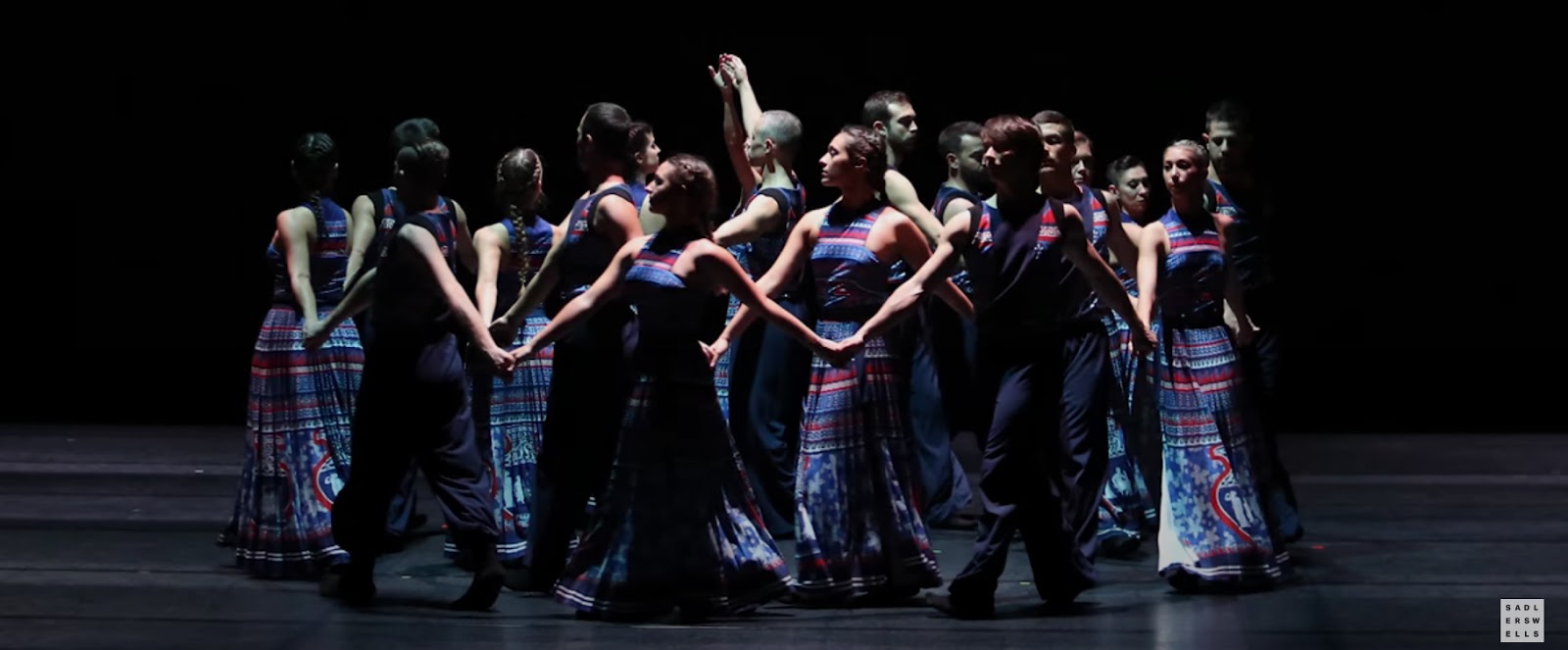
All stills are from the trailer of The Thread


The Sadler's Wells dance production The Thread has set out, with its central concept of the mythological thread, to explore "changing forms of traditional Greek dance" via the choreography of Russell Maliphant and the music composed especially for this production by Vangelis.

Such opus then needed a composer who could seamlessly move between, and even combine, ancient and modern, demolishing any boundaries in our perceptions of what musical elements are supposed to be rooted in what frame of time and space.

If one needed another demonstration of how Vangelis is able to compose music that transcends many historic periods' and geographic areas' musical tradition, then the score for The Thread is certainly one.

Naturally, in the introduction to the video presentation that premiered on 17 April 2020, his soundtracks for Blade Runner and Chariots of Fire got a mention, but here we are in a musical world that is more familiar to those who know his extensive and impossibly multi-faceted discography, which spans a seemingly absurd range of genres and styles.

The video is based on the world premiere, which took place in spring 2019 - and it was streamed, then later made available for one week on the dance company's Youtube channel.

The opening, with its drone, its subdued percussive sounds, and evolving ancient-but-futuristic sounding melodic motifs reminds us of the overture to his El Greco studio album (not the soundtrack of same title).

This, and some other sections of the score, are reaching a level of pure beauty that is often hard to process even without the imagery. A few notes from the by-now characteristic and instantly recognisable harp-like synthesizer sounds Vangelis used in the soundtrack to the epic movie Alexander can conjure a sense of immense serenity, timeless beauty - and the dancers seem to be floating on the sound waves...

The lighting design adds to the superlative choreography by Russell Maliphant: the lights create virtual spaces, sometimes splitting up the dancers into separate scenes, producing ever-changing staging of the movements. During the meditative third section of the score, the lighting design and the camerawork create something that is an audiovisual bliss - its purity and simplicity is mesmerising.

In other sections of the score, Vangelis makes us feel as if Mother Earth is pulsating with some ancient rhythm, menacing at times, animating and life-affirming at other times. If we recall Asma Asmaton from the album Rapsodies, well, those very pulsations seem to be now emerging from some unimaginably deep geological structure buried under the stage... and they reverberate outward, after animating the dancers, with the waves dying off somewhere at the peripheries of our known Universe...

This is what it means to think in sounds, not in genres, not in styles, not in preconceived boundaries of time and space.

Sampled whirls of sounds, ancient woodwinds, organic woodwinds of long gone millennia, and Earth-shattering percussion are all coming together in the ballet's most animated sections. However, after every unleashing of thundering forces, we have a chance to recompose ourselves.

The emotional effect of going from Alexander-like percussive passages to the serenity of achingly beautiful harmonies (which remind us of the unique musical world of the albums Odes and Rapsodies) is similar to a feeling of gently dissolving in some caressing wash of sound waves.

The range of the musical concept is, simply put, phenomenal.

We go from minimalist, completely stripped-down elements to towering sonic constructs, from the sound of some ancient gathering in immemorable times to Byzantine celebrations of life forces to somewhere in the outer realms of the Cosmos.

Is it the sound of an ancient army gathering or just a distant fete in some settlement impossibly far from us in space and time?

Are those drums or are those tectonic plates colliding, volcanic forces throbbing under them?

Is that a synthesizer, a sampled and processed ancient instrument, or an ethnic acoustic instrument that we listen to through some immersive voyage in a time machine?

Are those ancient flutes' sound reaching us through some labyrinth of caves, which managed to hide from us for millennia? Or is that some imaginative use of state of the art electronics?

Does it matter?

Vangelis has always said, and this is why people classifying him as an electronic artist are consistently wrong:  he does not care where the sounds come from. Due to the possibilities of technology, he just happens to utilise many electronic instruments to achieve the sound colours he imagines.

The Thread is, and remains, another perfect example of that ethos...


Credits: Artistic conception from Georgia Iliopoulou; lighting by fellow Sadler’s Wells Associate Artist, the “choreographer of light”, Michael Hulls; costume design by award-winning London-based Greek fashion designer, Mary Katrantzou.


Thursday, 16 April 2020

The quarantine waves...


Although one tries to resist the temptation for days and weeks, as the lockdown continues one eventually caves in... and posts a "quarantine playlist" of albums that seem to have originated from some other dimension, or have reached us via some electromagnetic waves emitted in some distant galaxy... or emerged from the habitat of previously not noticed tiny organisms.

Thus, on a personal note, a choice of a few albums that might just take someone else, too into the waves and vibrations of vast or infinitesimally small worlds.

The playlist is perhaps manageable in a single sitting (or, actually, lying...), but it needs a very quiet day with quite a few hours to just... be...


1. Tangerine Dream - Zeit 

Among the early, nowadays we would call it ambiental, albums by the veritable electronic music institution that Tangerine Dream has been since the 1960s, we have this double LP dating back almost fifty years...

The reason why I keep returning to this double album is that it is perhaps the most convincing example of 'space ambient'. What I understand and expect under that over-used label is music that simply seems to exist, without feeling that it is being performed by human beings, that there are instruments of any kinds involved in the process.

Zeit simply exists. It fills every available space in the room, in the house, it flows, it changes, it has currents and undulations. There are no shapes to hold on to, there are no structures to be self-conscious about.

It just is...

Yet, unlike many ambient drone music albums, it is constantly changing below its sometimes static-looking surface.

It is almost as if something, someone has managed to transpose into audible frequency range some radio telescope recording of the various electromagnetic activities spotted in distant galaxies.


2. Vangelis - Soil Festivities

On a quiet day, after a lengthy introduction via the sound waves and undercurrents of Zeit, the Greek grand master's mid-1980s concept album is immersing us into a very different world.

We go from the immense and the eminently "macro" to the delicate "micro" world, albeit latter is a very definitely terrestrial one.

Despite occasional sounds of summer storms and rain, this remains a phenomenal combination of minimalism and ambient music.

The delicate, obstinately repeating tiny motifs develop, constantly evolve, and get embellished by a discourse, sometimes a whole multi-party conversation, of other musical elements.

It could be the musical expression of the life of myriad tiny creatures in a rainforest on Earth, but it could equally be anywhere on some exotic other planet teeming with life. The pace of the musical evolution is hypnotising, the whole album has a dream-like quality whilst it seduces the mind with myriad, infinitesimal or large-scale, changes in the musical textures.

Speaking of textures, it is worth paying attention to just how every single synthesized timbre is chosen from the infinite possibilities of Vangelis's sonic laboratory - and how each timbre blends perfectly into the ever-evolving delicate textures.

Sublime, passionate at time, and precise in its dosing of musical energies... an album that is a very unusual and, to this day, unique interlude in the synth master's astoundingly varied output.


3. Michael Stearns - Encounter

The superlative American maestro of space ambient and world music-infused ambiental music has created something that is a rare example of thematic space music.

However, theme and track titles aside, one scandalous way to listen to this album is to not care about the intended narrative that wants to describe an encounter with an advanced alien civilisation.

We return to the world of Zeit, but here we have sometimes vast and thundering forces unleashed... the walls may wobble and neighbours in the street could wonder whether a UFO is actually in the process of landing somewhere.

There are many trademark elements in the compositional and sound design thinking that went into this Stearns album - characteristics that later we recognise in his masterpieces like the soundtracks to Ron Fricke's spellbinding Baraka or Samsara.

There are textures that shimmer and oscillate in mid-air in the room, there are huge floods of cosmic energies that storm through the room and fly off into the distance, leaving us stunned and mesmerised.

During this sonic voyage, we don't travel to distant galaxies, the Cosmos drops by for a visit...


4. Tangerine Dream - Rubycon

Just after their seminal Phaedra album, this one can leave one wondering whether it is the music of intricate inner or outer spaces.

It is, in its two tracks, a hypnotic voyage into some otherworldly spaces that seem to be at the same time cosmic and microscopic.

Maybe this is quantum music, that the late mastermind Edgar Froese talked about many decades later.

There is structure, there are tightly timed pulsations of impossible to grasp physical forces between particles, there are myriad infinitesimally tiny details and shifts in the forces at work... and there is, at the same time, complete fluidity and a sense of timelessness.

Like Soil Festivities, this seems to deep dive into a microworld - but this is not at the level of tiny living creatures, it is way, way below that.

We are listening to subatomic particles shaping up the vast constructs we see through telescopes...


5. Carbon Based Lifeforms - Twentythree

Unlike their pure ambient drone album VLA, this multi-part album has a rare combination of highly cerebral and emotive space ambient music.

It is a very rare experience, after having gone through many decades' output in aforementioned genre, to find something that is so abstract, so devoid of any tangible shape, but at the same time so emotionally charged.

The subtle melancholy of tracks like Held Together By Gravity is sublime and simply beautiful...

Although the creative duo, as we all know, is capable of thundering beats and trendy psy-trance vibes, too, this album is a phenomenally delicate affair.

Despite some of the track titles, which may be pointing us toward Earthly mysteries, we are in outer space... or, at best, in some caves nobody else has yet discovered.

The music gives us something to hold onto, there are tiny shapes we can see in the gaseous clouds, but it gives enough space for imagination to wonder. We can imagine whatever we want, especially if we do not look at the track titles.


6. John Serrie - The Stargazer's Journey

A relatively tiny journey to the American continent can keep us firmly in the sphere of utterly cosmic, but delicately emotive, space ambient.

One of the masters of space electronica from the other side of the Atlantic has this quite exquisite constellation hiding in his discography. It is recent, it is from the new Millennium, but, in a good sense, it sounds like the most stellar 1970s-1980s achievements of space music.

The entire sonic landscape has some intangible gentle melancholy, a sense of one dreaming to be somewhere else in some distant corner of the Cosmos, but at the same time feeling nostalgic about one's own home world.

To sculpt every sound and every transition between what seem to be undulations of gentle clouds of particles, but to make it all feel so fluid, effortless, and without tangible human intervention... well, we are back to the world of Zeit.

If Zeit started us off with the hidden vibrations and currents of indescribable cosmic interactions that exist and will continue to exist independently from us, The Stargazer's Journey is a slow flight among gas nebulae that trigger emotions in us by their, dare we say, otherworldly beauty.

In today's world, where music has been increasingly put into utilitarian pigeonholes (i.e. music meant to relax us, to heal us, to entertain us etc.), we ended up being extremely distant from the Pythagorean ideal of what the 'music of the spheres' is supposed to be.

Serrie's album is a good counterpoint. Yes, it can instantly relax us from it first few seconds, but it is something that defies expectations on what a 'space music' composer sets out to do and why...


Sunday, 8 March 2020

S-A-W waves of the past, Ghosts of the present


In somewhat quick succession, certain camps of electronic music afficionados could treat themselves to two new releases with stellar pedigree...

After some solo and group ventures, one of the pivotal ex-members of Tangerine Dream, Johannes Schmoelling has teamed up with Kurt Ader, and Robert Waters under the S-A-W project name.

Their first outing on a full-blown album wears the aptly chosen title Iconic...

Two characteristics can be noticed immediately when listening to the album.

First of all, we are on very cosy and familiar territory in terms of the sub-genre of electronic music we are being treated to. No major surprises, no stylistic shocks, and thankfully no drifting into highly commercial trendy territories. This is competent and confident "Berlin School" electronica, as the first delayed sequencer patterns tells us some seconds into the first track.

Secondly, we might be able to distinguish very specific personal styles (e.g. Schmoelling's chromaticism is instantly recognisable), but this musical collaboration is one that gels very well, so-to-speak. The individual contributions are combining very well, without very firm separation lines running through the music material.

In terms of range, we are treated to quite a lot. From high-spirited sequencer patterns to vintage vocoders to catchy melodic leads to almost improvisation-sounding piano wanderings we have everything here. The album has even a rather dark and atmospheric middle section, when things turn more experimental.

Some of the tracks have the feel of a very successful jam session, with lead motifs hovering above a bed of confidently ticking and spiraling sequencer motifs. Some are so catchy that are venturing almost into the territory of retro synthwave tunes.

With the risk of sounding as if one is expecting some magnanimous musical innovation, instead of a comfortable return to quintessential Berlin School musical language... one aspect of this album is just that: it is a return to something very welcomed but also very familiar.

In many ways, this is a retrospective look at a musical language that is very close to our Tangerine Dreaming hearts & minds, hence one can very much welcome it and enjoy it. However, it really is gazing into the past - and the intention seems clear, with the use of vocoders, certain specific patches, and truly vintage sweeping filtered noise effects and the like.

One can very much hope this is just the first S-A-W album of many, and hopefully this collaboration will have more longevity than Loom had.

Something that is, however, very "now" is the new album by another eminent ex-Tangerine Dream member, Paul Haslinger.

After a number of high-profile or unfortunately overlooked soundtracks, too, one might expect an energetic and possibly high-octane electronic journey. Instead, the album that was born out of almost a decade of piano improvisations brings us something highly contemplative and introspective.

If we experienced delicious nostalgia whilst listening to Iconic, Haslinger's album Exit Ghosts is something from a vastly different musical Universe.

If one takes Ryuichi Sakamoto's astonishingly delicate album async [sic], any of Olafur Arnalds's more piano-centric solo works, or Nils Frahm's piano textures, then one can build an image about that particular Universe.

Exit Ghost is firmly situating itself in that sonic world. Again, no major surprises and no huge leaps into some never before heard experimental directions... However, the rather special beauty of this album is just how subtle and seamless the musical journey is.

We get almost translucent textures like some sonic nebulae, with infinitely delicate tiny motifs. Every piano note has its own life, sometimes we can hear them blending in with the sonic textures, in other moments they hover on their own in mid-air and make us appreciate the delicate process that created them.

Once again would commit here the sacrilege of not going through the album in a track-by-track fashion - as, perhaps even more so than Iconic, Exit Ghost works best as part of a full album listening experience.

There are moments of such delicate sonic sculpting that it makes one think of the most vaporous and subtle moments of Thomas Newman soundtracks, where a single sound can express seeming impossible range of things. There are moments of melodic motifs that will not go away in the mind, and will hover around the room for many hours after the album itself finished playing.

As abstract as it may sound to say this, and even ludicrously "new age" in terminology, but Exit Ghost is like a highly meditative sonic cleansing that will push away all the madness and turmoil of the everyday reality. It does this without being that type of empty musical escapism that we find in myriad "new age" records - and this album comes with a huge degree of artistic honesty.

In our noisy and trend-chasing world, it is quite a fete to be treated to two such albums, both very firmly rooted in their own respective, and vastly different, sonic Universe.

After a journey into a splendid and Iconic past, as different as it is, giving a spin (or a streaming) to the here-and-now expressive minimalism of Exit Ghost is a highly recommended double treat.


Wednesday, 22 January 2020

Organic chemistry: That Which Prevails, the new album by Computerchemist


Computerchemist's ninth album is a solid island of complex Berlin School-style electronica in an ocean of myriad other mainstream / trendy electronic music releases. Once again, instead of taking some 'fashionable' commercial route, the music is true to its central aesthetic - and delivers on that.

The presence of 'organic' instrumentation in the electronic landscape is (or always should be) a very welcomed artistic choice. If one recalls Klaus Krieger's or Chris Franke's drumming on Tangerine Dream records, Klaus Schulze's drumming on his solo albums, or Manuel Göttsching's guitar improvisations enveloped by Schulze's electronic textures, then one knows what these combinations can deliver as an experience for the listener.

What we have here is much more electrifying than a purely synthesised soundscape. Dave Pearson's guitars and the drumming by Zsolt Galantai (of, among others, Ossian fame) adds a vital organic element to the Berlin School sound unfolding in these tracks.

We have tight sequencers, which are captivatingly pulsating and giving structure to the tracks' lush atmospherics, PPG Wave-like characteristic sonic gems (check out the final track especially), and impossible to resist mellotron-like textures. Everything a Berlin School aficionado could possibly want...

However, in addition we have fluid and, one dares to say, emotive guitar leads, with aforementioned drums on the third track. Even the drum programming on the other tracks feels organic and eminently non-robotic, unlike what happens in some other eminently synthesised, even synthetic, sonic journeys.

It makes the tracks feel more fluid, ever-changing, without static sequencer patterns. Things constantly develop, which is increasingly rare in latter-day Berlin School records & jams inundating the internet.

The opening track is already landing us in catchy Berlin School territory, and characteristically, the sequencers are there to provide structural support to animated electronic rock, rather than totally taking over.

Time Is A Great Healer (parts iii-iv) is another good example where we may believe we are in for a digital trip, as PPG Wave-like sounds open the composition, but then we can quickly take a flight with guitars making a solid appearance...

A Dali-esque Dreamer is a superb homage to Edgar Froese, who passed away five years ago. It once again shows how the tracks do not stand still and there is solid compositional development, whilst keeping an almost improvised feel, too with the guitar leads.

The title track, That Which Prevails is again a perfect example how a retro-sounding organ intro can develop into a fiery electronic rock piece.

Yours truly used to say, even write, about classic TD and Schulze gems that there were no straight lines, only waves and curved surfaces in those records. The same accolade applies to this album, too.

While there is clear compositional thinking with structural development, each track achieves that sense of catchy fluidity that normally only comes with inspired improvisations.

Computerchemist's catalogue can be purchased on CD from CDbaby.com and amazon.com in the US or direct from the artist's site via bandcamp.com. Digital distribution is through bandcamp.com, CDbaby.com, Apple iTunes, Spotify and other popular streaming services.